
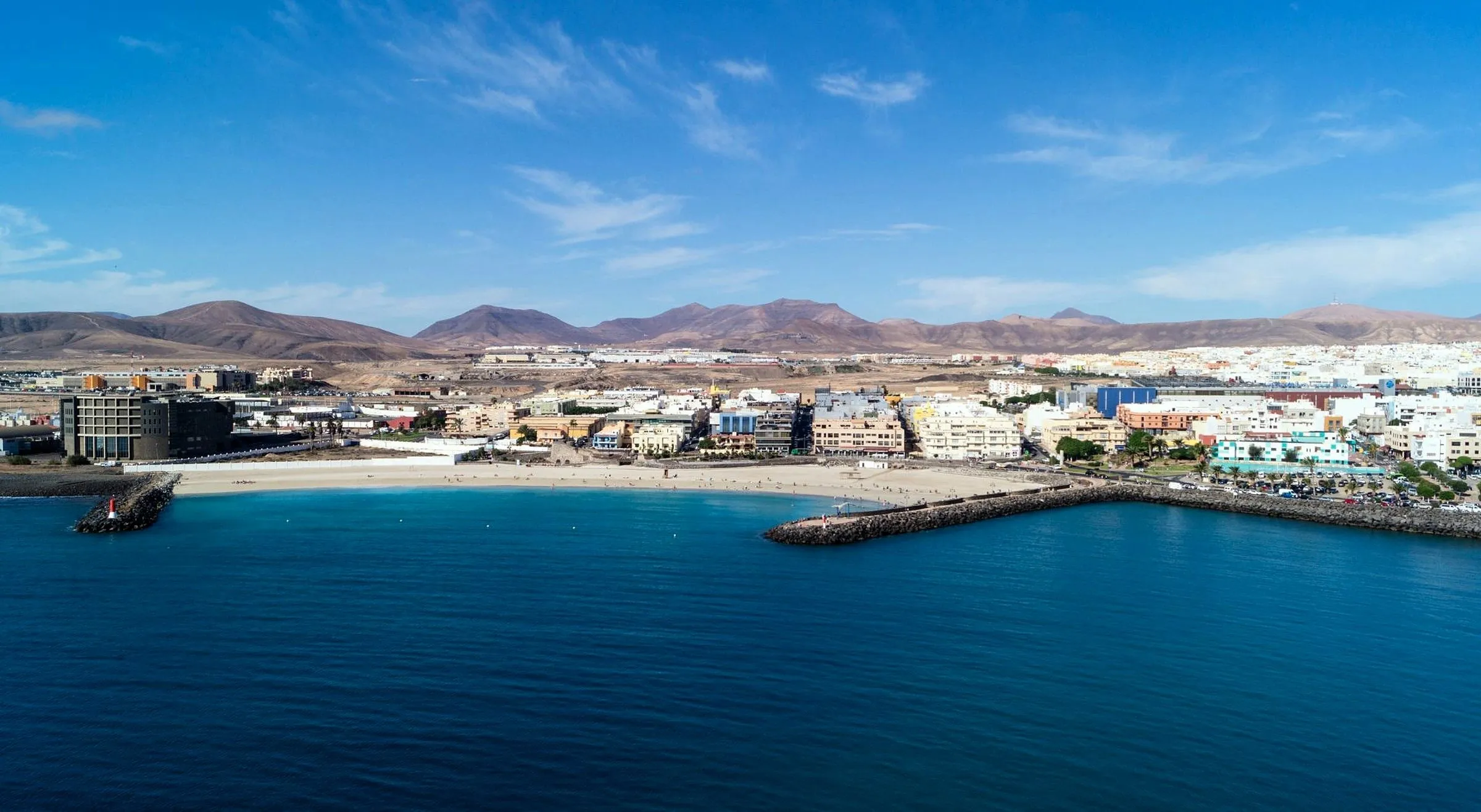

From Goat Harbour to capital
Puerto del Rosario is the capital of Fuerteventura and the centre of its administration, trade and transport. More of the island’s people live here than anywhere else: at the start of 2025 the municipality had just over 46,000 inhabitants. The town sees few tourists, and that’s exactly what makes it interesting – here you see how the Majoreros, the islanders, really live.
The town is young. For a long time the bay was just an anchorage on a coast grazed by herds of goats – hence the old name Puerto de Cabras, “Goat Harbour”. A permanent settlement only grew up here towards the end of the 18th century, as shipping increased.
In 1860 the town became the island’s capital. By 1956 Goat Harbour was no longer refined enough for the residents, and they renamed their town after its patron saint, Our Lady of the Rosary: Puerto del Rosario, “Harbour of the Rosary”. In everyday speech many people simply call it “Puerto”.
Uns gefällt vor allem, dass Puerto del Rosario noch eine richtige Stadt ist, in der nicht alles auf Touristen ausgerichtet ist.
The beaches: Playa Chica and Playa Blanca
Right in the middle of town is Playa de los Pozos, which everyone just calls Playa Chica. The small bay is light-coloured and calm, and the people swimming here are mostly locals. It holds the Blue Flag for 2026.
South of town, towards the airport, is Playa Blanca, much bigger and less developed. To the north comes Puerto Lajas, with dark sand and a quiet bay. Both also hold the Blue Flag for 2026.
We’ve been to both beaches. They’re fine for a short stop, but if you know the sandy beaches in the south that stretch for miles, these lack that certain something. We wouldn’t come here specially for a swim or a long walk on the beach. At Playa Blanca you can also hear the planes – the airport is close by.
Promenade, sculptures and murals
The whole town is an open-air museum. Since 2001 Puerto del Rosario has been bringing sculptors to town for symposiums, and according to the town council there are now more than 180 sculptures in its streets, on its roundabouts and in its squares. Wandering about without a plan is enough to see dozens of them. On top of that there are the colourful murals on the walls of many buildings, so there’s something new to discover on every visit.
The best part is the redesigned harbour promenade, with palm trees, benches and a view of the breakwaters. When a cruise ship is in port, it’s busier here.
A few streets inland stands the church of Nuestra Señora del Rosario. Opposite it is the Casa Museo Unamuno, in the former Hotel Fuerteventura. This is where the Spanish writer and philosopher Miguel de Unamuno lived in 1924, after the dictatorship had exiled him to the island. He later immortalised Fuerteventura in his poems.
Art for free: close to the harbour, the Centro de Arte Juan Ismael shows works by the island painter it is named after, along with changing exhibitions of art from the Canaries and mainland Spain. Entry is free, and it’s open Tuesday to Saturday. The Casa Museo Unamuno costs nothing either; it’s open Monday to Friday.
What I tell friends: the harbour promenade first, then the streets around the town centre with their sculptures and murals, and finally sit down somewhere for a coffee and just watch the comings and goings. For a short stroll, that’s just right.
Food, shopping and festivals
For shopping, Puerto del Rosario is where you go for everyday things. There are lots of shops in the town centre, especially around Calle León y Castillo, plus the big Las Rotondas shopping centre with a supermarket. The bars and restaurants cater for locals: tapas bars, cafés, simple restaurants.
Fish with a sea view: El Cangrejo Colorao on Calle Juan Ramón Jiménez serves fresh fish, seafood and rice dishes, and you look out at the sea through the big windows and from the terrace. If you prefer something more traditional, head to the fishing village of Puerto Lajas north of town – more on that below.
If you’re self-catering, the farmers’ market on Avenida de la Constitución is worth knowing about, with fruit, vegetables, bread and goat’s cheese (queso majorero).
There are festivals throughout the year. Carnival in February or March brings parades and a new theme every year. Around 7 October comes the festival of the town’s patron saint, the Fiesta de la Virgen del Rosario, with concerts and a romería, a festive pilgrimage.
Weather and sea temperature through the year
This is what an average year looks like: day, night and sea, month by month. Air temperatures come from the weather station at the airport; the sea figures are for the waters off Corralejo on the north coast. Our guide Best time to visit Fuerteventura tells you which month suits you.
Tap a month to see all figures
| Month | Day (average high), °C | Night (average low), °C | Sea, °C | Sunshine (hours per day) | Rainy days (≥ 1 mm) |
|---|---|---|---|---|---|
| January | 20.8 | 14.9 | 18.9 | 6.3 | 2.3 |
| February | 21.1 | 14.9 | 18.3 | 6.8 | 1.9 |
| March | 22.3 | 15.5 | 18.3 | 7.7 | 1.8 |
| April | 23.2 | 16.4 | 18.8 | 8.3 | 0.8 |
| May | 24.7 | 17.7 | 19.7 | 9.2 | 0.2 |
| June | 26.3 | 19.5 | 20.9 | 9.5 | 0.0 |
| July | 27.5 | 21.1 | 21.7 | 9.8 | 0.0 |
| August | 27.9 | 21.9 | 22.5 | 9.4 | 0.1 |
| September | 27.5 | 21.5 | 23.0 | 8.7 | 0.5 |
| October | 26.4 | 20.2 | 22.8 | 7.3 | 1.8 |
| November | 24.2 | 18.0 | 21.5 | 6.5 | 2.1 |
| December | 22.1 | 16.1 | 20.0 | 6.2 | 2.6 |
Air: © AEMET, climate normals 1991–2020, Fuerteventura Aeropuerto station · Sea temperature: Copernicus Marine Service (EU) – Generated using E.U. Copernicus Marine Service Information, monthly means 1991–2020
Practical tips: bus, taxi, hospital
From the airport you’re in town within a few minutes. By bus, take TIADHE route 3 or 10. Many of the island’s buses start from the central bus station, the Estación de Guaguas. From here you can get to Corralejo, El Cotillo, Caleta de Fuste and the south without a car. Current times are on tiadhe.com.
A taxi from the airport costs about €14 on the meter, a little more at night, on Sundays and on public holidays. There are no fixed prices.
Important for every visitor: Puerto del Rosario is home to the Hospital General de Fuerteventura, the island’s public hospital. You’ll also find government offices, banks and the big shops here – for many everyday matters, the town is the first place to go.
Cruise ships call at the harbour regularly. If you’re getting around in a hire car, expect town traffic, and you won’t always find a parking space right outside where you’re going.
Ashore from a cruise ship: how to make the most of your time
Cruise ships berth right in the middle of town, at the cruise pier on the harbour promenade. It’s about 300 metres to the port exit, and from there you’re in the shopping streets within a few minutes. Taxis wait at the terminal.
Three hours: the town on foot
Start with the harbour promenade and its sculptures, then walk up to the church and the Casa Museo Unamuno directly opposite. On the way back, the Centro de Arte Juan Ismael is worth a stop. If you want a swim, Playa Chica is only about 600 metres south of the cruise pier.
Five to six hours: further afield
From the central bus station, a good kilometre inland, route 6 runs to the dunes at Corralejo and route 3 to Caleta de Fuste and Las Salinas. By taxi or hire car you have more flexibility and can get into the interior too. Always allow plenty of time to get back to the ship.
Where to stay in Puerto del Rosario
We’ve never stayed here ourselves; this overview is based on our research. To be honest, the town isn’t a holiday resort with a big choice of hotels. People who stay here usually want to be central for the bus and for errands, or to explore the island without a car.
At the harbour: JM Puerto del Rosario is a town hotel on the seafront road, opposite the cruise pier. At Playa Blanca: Hotel El Mirador de Fuerteventura sits above Playa Blanca, a little outside the town centre. There are also a few simple guesthouses in the town centre.
Around Puerto del Rosario: day trips nearby
Puerto del Rosario sits in the middle of the east coast, so you can reach almost anywhere on the island easily from here. Nearby, these are the places most worth visiting:
Puerto Lajas: fishing village with a dark beach
About 5 km to the north as the crow flies is the small fishing village of Puerto Lajas. The dark beach is about 700 metres long, with showers and a playground. Lots of locals come at weekends, and there are fish restaurants in the village.
Tefía: the La Alcogida open-air museum
About 14 km inland as the crow flies, the Ecomuseo La Alcogida uses seven restored houses to show how the island’s farming families lived from the 19th century until a few decades ago: bread ovens, stables, old water stores, plus goats, donkeys and camels. Craftspeople work on site, and you can watch them at it.
La Ampuyenta: a village full of history
On the road to Antigua lies the little village of La Ampuyenta. The Cabildo (island government) has set up a small group of cultural sites here: the birthplace of Dr Mena, a doctor who treated the villagers free of charge, the Hospitalito (small hospital) he got started, and the house of the Franciscan friar Fray Andresito. In 2026 three historic paintings were restored in the village chapel.
Caleta de Fuste and the Salinas del Carmen
About 13 km to the south is Caleta de Fuste with its sheltered swimming bay, Playa del Castillo, and just beyond it the Salinas del Carmen with the salt museum. Bus route 3 serves both.
The north and the centre of the island
Route 6 takes you to the dunes at Corralejo without a car, and route 7 goes to El Cotillo. In the centre of the island is Betancuria, the old capital, and in the south Costa Calma. You’ll find all these places on our island map.
Is Puerto del Rosario worth it?
As a place for a holiday, not really; for a stroll of a few hours, yes. If you’re used to hotel complexes and beach days, you’ll see a different side of the island here: perfectly ordinary everyday life. For self-caterers, long-stay visitors and anyone without a hire car, the town can even make sense as a base, because a lot of bus routes meet here.
For us Puerto del Rosario isn’t a must like Betancuria – more an occasional stop on the way somewhere. We drop in on roughly every third or fourth holiday, most recently in January 2026, though only on the edge of town that time. Still, it’s worth seeing the town once.
What we don’t like
What we miss here is the special charm that many other places on Fuerteventura have. In places the town feels grey, hectic and not very inviting. Add to that the traffic and some fairly plain buildings.
If you’re expecting a pretty old town with narrow lanes, cosy restaurants and plenty of holiday atmosphere, you’ll probably be disappointed here. For a short stroll Puerto del Rosario is quite interesting, but we wouldn’t set aside a whole day for it.
Then and now
| What | 1997 | Today |
|---|---|---|
| Size | small, manageable port town | much bigger, more residential areas on the outskirts |
| Harbour and promenade | promenade not yet redesigned | redesigned promenade with palm trees and benches |
| Sculptures and murals | sculpture symposiums did not start until 2001 | more than 180 sculptures, colourful murals |
| Townscape | simple, few tourists | more modern, but still grey in places |
| Our impression | a fascinating look at island life | has gained quite a bit, but we still miss the charm |
Puerto del Rosario has changed considerably since my first visit in 1997. The town has grown and become more modern, and with the promenade, the sculptures and the murals it has gained quite a bit. But we still miss that special charm here.
