

Corralejo: from fishing village to the north’s biggest resort
Corralejo lies at the very top of Fuerteventura, facing Lanzarote and the small Isla de Lobos. It belongs to the municipality of La Oliva and is now one of the liveliest holiday resorts on the island. In 2024 the locality had around 18,800 inhabitants, a good 10,600 of them in the town centre.
Corralejo isn’t old. There has only been a permanent settlement here since the 19th century, and some of the first families came from nearby Lanzarote. Until the middle of the 20th century Corralejo remained a small fishing village. Tourism reached the north in the early 1970s, and since then hotels, apartment complexes and villas have gone up.
Today Corralejo is colourful, international and young. The busiest areas are around the harbour and in the old fishermen’s quarter. The main shopping street is Avenida Nuestra Señora del Carmen. When I first came here in 1996, the place felt rather low-key: nice streets to stroll along, and nobody was pushy.
The reason to head north: the dunes of Corralejo
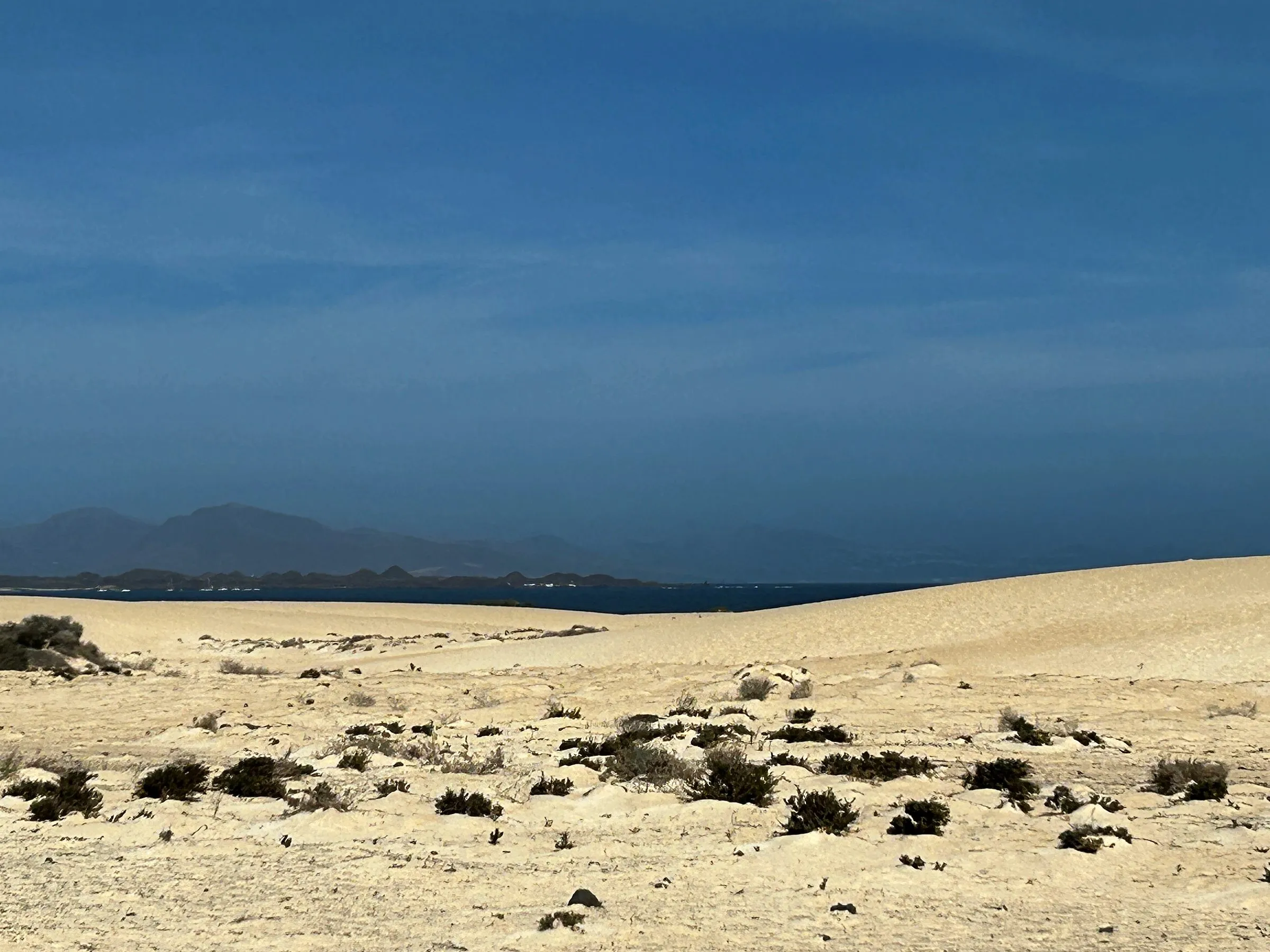
Just south of Corralejo begins the Parque Natural de las Dunas de Corralejo, a nature park of pale, shifting dunes. For me it’s the reason you have to go north. You won’t see anything like it anywhere else. The area has been protected since 1982, and nothing is built here any more. The dunes stretch from the sea far inland, and behind them rises the reddish volcanic cone of Montaña Roja, the “Red Mountain”.

The FV-1 towards the island’s capital runs right through the dunes, and in places the sand blows onto the road. Stop in one of the lay-bys, take your shoes off and walk a little way through the sand – all the way to the sea if you like. From slightly higher ground you can see across all the sand to the water. Keep to the open sand as you go: the plants in the dunes are fragile and hold the sand in place.
Getting to the dunes: From the town centre it takes about eight minutes by car to reach Grandes Playas. You park in the lay-bys and parking areas along the FV-1.
Wir genießen den Ort lieber für ein paar Stunden und freuen uns anschließend auch wieder auf die Ruhe im Süden.
Every November the international kite festival, the Festival Internacional de Cometas, takes place – in 2026 from 9 to 15 November. In 2025 more than 200 kite fliers from all over the world flew their kites over the beaches of Corralejo and El Cotillo.
The beaches of Corralejo: quiet town coves, wild dune beaches
Corralejo’s best beaches aren’t in town but south of it, in the dunes nature park. In town itself there are small coves by the harbour and along the promenade. The Corralejo Viejo town beach got its Blue Flag back in 2026; the water here is usually calm, which is good for families with small children.
The main attraction is Grandes Playas, a kilometres-long strip of pale, fine sand in front of the shifting dunes. Incidentally, the sand isn’t from the Sahara: it is made mostly of finely ground shells and other calcareous fragments from the sea. Grandes Playas also has the Blue Flag in 2026. In the middle of the nature park stand two large hotels from the 1970s, built shortly before the area was protected. The further you get from town, the emptier it becomes. Nude bathing is tolerated on some stretches.
There’s a lot going on with the two dune hotels at the moment: the RIU Palace Tres Islas is being refurbished and is due to reopen in April 2027 as an adults-only hotel. For the RIU Oliva Beach, the Spanish environment ministry declared the concession expired in 2024 and ordered the hotel to be demolished; RIU is fighting this in court.
When the surf is up, currents form at Grandes Playas, so don’t swim out far here. Flag Beach on the edge of town is a spot for kitesurfers and windsurfers and is not suitable for swimming.
Wind is simply part of life in the north. In summer it often blows hard on the dune beaches, which is exactly why there are so many kitesurfers and windsurfers out here.
Coffee in hand along the boats: Corralejo harbour
The ferries to Lanzarote and Isla de Lobos leave from Corralejo harbour. The crossing to Playa Blanca on Lanzarote takes about 25 to 35 minutes, and the ferries run daily all year round. The operators are Fred. Olsen Express, Baleària and Líneas Romero. So a day trip to Lanzarote is very doable. We went over once, around 2005, by ferry with our own car. You’ll find times and fares directly on the ferry companies’ websites.

Little Isla de Lobos lies just two kilometres off Corralejo and is a nature park. The ferry gets you there in a few minutes; you can walk all the way round the island or up the small volcano, and swim at the calm Playa de la Concha. For Lobos you need a permit from the Cabildo, the island government, which you apply for online in advance via the Lobos Pass. Our permit cost nothing in 2023, but a fee is planned, so check when you apply. There are two time slots a day, morning and afternoon, each with a maximum of 200 visitors. One application covers up to three people, and you can book no more than three days in advance. You can be checked on Lobos at any time, and you may not stay without a permit.
I always take in the harbour itself: stop for a moment, take a few photos, or stroll along past the boats with a cup of coffee. I love it. Boat trips also leave from the harbour.
Things to do in Corralejo: water park, water sports, boat trips
Acua Water Park: Corralejo’s water park has more than 14 slides and pools, split into areas for families, for small children and for anyone who likes it fast. It is open in season – in 2026 from late March to early November. Just right when the children need a day off from the beach.
Surfing, kitesurfing, wing foiling: Corralejo is one of the island’s water-sports centres. On the dune beach, for example, the Flag Beach water-sports school offers lessons and equipment hire for surfing, kitesurfing, windsurfing, wing foiling and SUP. If you’ve never stood on a board, it’s best to practise on calm days in the sheltered coves in town.
Boat trips to Lobos: Excursion boats and catamarans leave the harbour for Isla de Lobos, often with a snorkelling stop and a drink on board. You need the Lobos permit for these too. On some tours the operator takes care of it – it says so in the description of the trip.
Eating and going out in Corralejo: our wine bar in the old town
You’ll find most of the fish restaurants around the old harbour, and most of the nightlife in the old town and on the main street. Typical dishes are fresh fish, papas arrugadas (wrinkled potatoes) with mojo (a spicy sauce) and queso majorero, the island’s goat’s cheese, which has protected designation of origin status.
Our favourite spot is the Domenoteca in the old town, on Calle La Ballena – a wine bar that also serves food. The menu has fish and, above all, wines from Fuerteventura itself. That’s a real rarity on the island. The Domenoteca is family-run and very warm and welcoming; we’ve been several times.
Corralejo is known as one of the places with the liveliest nightlife on Fuerteventura. The bars, pubs and live-music bars are mainly in the old town and on the main street. If you want to go out in the evening, this is the place; if you want peace and quiet, don’t stay right in the old town.
For shopping, Avenida Nuestra Señora del Carmen is the first port of call, with boutiques, surf shops and souvenir shops. Markets: On Tuesdays and Fridays there is a weekly market with crafts and accessories from 9am to 2pm. On Thursdays and Sundays, also from 9am to 2pm, the Mercado Canario, the Canarian market, is held at the El Campanario shopping centre. Times may change.
In July Corralejo celebrates the Fiestas del Carmen in honour of the fishermen’s patron saint; the main day is 16 July, with a procession at sea. Then there’s the carnival, whose dates change every year.
Where to stay in Corralejo: which area suits you?
We’ve never stayed overnight in Corralejo ourselves – we come for the day. What you read here is our research. In Corralejo, more than in most places, where you stay shapes the kind of holiday you’ll have:
- Old town and harbour: restaurants, bars and the ferries to Lobos and Lanzarote are all close by. It’s busy here in the evenings, and sometimes noisy. If you want an early night, look for somewhere away from the bar streets.
- On the promenade and the town beaches: the sea on your doorstep and still within walking distance of the centre. Good for anyone who wants to combine strolling and swimming.
From our research: Avanti Lifestyle Hotel, a small boutique hotel with 15 rooms in the centre opposite the beach, with a roof terrace and hot tub, adults only. Good for couples who want to stay right in the middle of town.
- Towards Flag Beach and the dunes: closer to the big beaches and the water-sports schools. It’s a longer walk into the centre, or you take the car.
From our research: H10 Ocean Dreams is on Calle Las Palmeras, just a few steps from the main street and close to the dunes. An adults-only boutique hotel with a heated pool and spa area. Right by the sea on Avenida Grandes Playas, towards the dunes, is the Secrets Bahía Real Resort & Spa, a large luxury resort with a spa, for guests aged 16 and over. In this part of town, families will mainly find apartment complexes.
- In the dunes: There are only the two RIU hotels here, one of them closed for refurbishment until 2027 (see above).
- A village rather than a resort: If you like it quiet, stay in Lajares or El Cotillo and drive into Corralejo just to stroll and eat.
There is accommodation in every price range, from simple apartments to five-star hotels. At Christmas, Easter and in summer it’s best to book early.
Weather and sea temperatures through the year
This is what the year looks like on average: day, night and sea, month by month. Air temperatures come from the weather station at the airport; the sea values apply off Corralejo on the north coast. Our guide Best time to visit Fuerteventura covers which month suits you.
Tap a month to see all figures
| Month | Day (average high), °C | Night (average low), °C | Sea, °C | Sunshine (hours per day) | Rainy days (≥ 1 mm) |
|---|---|---|---|---|---|
| January | 20.8 | 14.9 | 18.9 | 6.3 | 2.3 |
| February | 21.1 | 14.9 | 18.3 | 6.8 | 1.9 |
| March | 22.3 | 15.5 | 18.3 | 7.7 | 1.8 |
| April | 23.2 | 16.4 | 18.8 | 8.3 | 0.8 |
| May | 24.7 | 17.7 | 19.7 | 9.2 | 0.2 |
| June | 26.3 | 19.5 | 20.9 | 9.5 | 0.0 |
| July | 27.5 | 21.1 | 21.7 | 9.8 | 0.0 |
| August | 27.9 | 21.9 | 22.5 | 9.4 | 0.1 |
| September | 27.5 | 21.5 | 23.0 | 8.7 | 0.5 |
| October | 26.4 | 20.2 | 22.8 | 7.3 | 1.8 |
| November | 24.2 | 18.0 | 21.5 | 6.5 | 2.1 |
| December | 22.1 | 16.1 | 20.0 | 6.2 | 2.6 |
Air: © AEMET, climate normals 1991–2020, Fuerteventura Aeropuerto station · Sea temperature: Copernicus Marine Service (EU) – Generated using E.U. Copernicus Marine Service Information, monthly means 1991–2020
Arriving smoothly in Corralejo: getting there, taxis and parking
From the airport it’s about 35 minutes by car, just under 40 kilometres north on the FV-1. There is no direct bus from the airport to Corralejo. You take TIADHE island bus line 3 or 10 to Puerto del Rosario and change there to line 6 to Corralejo. Line 8 goes to El Cotillo. Current timetables are on tiadhe.com.
A taxi from the airport costs about €57 to €65 on the meter, more at night, on Sundays and on public holidays. There are no fixed prices. Older websites quote much lower fares, which are no longer correct. If you’re planning lots of trips, you’re more flexible with a hire car.
Parking spaces are in short supply in Corralejo. You often spend a long time looking, and it has got noticeably worse in the years since Covid. Best to come early or leave the car at your hotel.
Everything you need day to day is here: pharmacies (farmacia), supermarkets, banks, cash machines and a health centre.
Day trips from Corralejo: up the Bayuyo and into the wild north
Corralejo is a good base for exploring the north of the island. Besides Lobos and Lanzarote, lots of places are within half an hour’s drive.
The classics by car from Corralejo:
- Dunes and Grandes Playas: about 8 minutes
- Lajares and the Calderón Hondo crater: about 15 minutes
- La Oliva: about 18 minutes, with the Casa de los Coroneles (cultural centre in the old manor house, free entry), the church of Nuestra Señora de la Candelaria and the Casa Mané art centre
- El Cotillo: lagoons, fishing harbour and sunset, about 20 minutes
- Isla de Lobos: by ferry from the harbour, permit only
- Lanzarote: by ferry to Playa Blanca in 25 to 35 minutes

In November 2023 we climbed Bayuyo. We had driven up north from Costa Calma, stopped in Corralejo for a quick bite and to fill up with petrol, and then went straight to the volcano, which is just behind the town. From the top you get a wide view over Corralejo and the dunes across to Lobos – you can make out the little island clearly from up there. I also took photos with the drone that day.
To the west, a dirt track runs along the north coast to the small fishing hamlet of Majanicho and on towards El Cotillo with its lagoons and sunsets. Your hire agreement decides whether you’re allowed to take a hire car on dirt tracks. With our hire company, Cabrera Medina, it isn’t allowed in any of their cars, not even the jeep, and if you do it anyway, you pay for any damage to the underside yourself. Also on the north coast is the so-called Popcorn Beach, a beach made of little white grains of calcareous algae that look like popcorn. Please leave them where they are – taking them away damages the beach. The north coast is hardly suitable for swimming because of the waves and rocks.
The names of the volcanoes are easy to mix up: the better-known crater, Calderón Hondo, is a little further on near Lajares, with an easy walk up to it. Further south, the old main town of La Oliva and the holy mountain of the island’s original inhabitants, Montaña de Tindaya, are worth a visit. And if you want to go to the island’s capital, Puerto del Rosario is just under half an hour to the south. You’ll find all these places on our island map.
Corralejo or El Cotillo: where to stay in the north?
Corralejo is livelier and better developed; El Cotillo is quieter and more traditional. We always enjoy coming back to Corralejo, wandering through the lanes, looking in the shops, having a coffee somewhere or a relaxed meal. But we wouldn’t want to stay here. For us the place has become too crowded, too built up and sometimes too hectic. We prefer it quieter – long morning walks on the beach and not having people around us all the time.
If you like going out, wandering the streets in the evening and having restaurants and bars on your doorstep, you’ll love Corralejo. If you prefer somewhere quieter in the north, take a look at El Cotillo, with its lagoons, fishing harbour and sunsets. Driving from one end of the island to the other takes a good hour and a half. If you’re staying in the south, it’s best to set aside a whole day for the north, as we do.
| What | Corralejo | El Cotillo |
|---|---|---|
| Atmosphere | lively, international, young | quiet, fishing village, surfers |
| Evenings | bars, music, old town | dinner and sunset |
| Swimming | town coves, big dune beaches outside town | lagoons in the north, dangerous beaches to the south |
| Day trips | Lobos, Lanzarote, dunes | west coast, Lajares, Calderón Hondo |
| Accommodation | wide choice, hotels | apartments, holiday homes |
| Parking | in short supply, you can search for ages | mostly relaxed, centre is tight |
| Airport | approx. 35 minutes | approx. 40 minutes |
| Suits | people who like going out, water-sports fans, holidaymakers without a hire car | people looking for peace and quiet, surfers, families at the lagoons |
Crowds and hunting for a parking space: what bothers us about Corralejo
Hunting for a parking space is the most annoying thing. It has got really bad in the years since Covid – you often end up driving round for ages. The shopping streets and the harbour are also very busy, at least by Fuerteventura standards. And the town has grown a lot, with lots of apartment complexes. I don’t count the wind in summer – that’s simply part of the north.
Sand on the road: Corralejo in 1996 and today
| What | 1996 | Today |
|---|---|---|
| Atmosphere | less going on, still unspoilt | crowded, especially in high season |
| Dunes and road | mounds of sand on the road, little diggers clearing it | sand still blows onto the road, the nature park is protected |
| Town | rather low-key, quiet streets to stroll along | densely built up, lots of apartment complexes |
| Parking | we didn’t notice it | in short supply, much worse since Covid |
In 1996 it was my first flight ever – and straight into another world. That white expanse behind the town has stayed with me to this day.
