

Lajares: from farming village to surfers’ hangout
Lajares is a small inland village in the north, in the municipality of La Oliva, with around 2,000 inhabitants. It lies between Corralejo and El Cotillo, a few kilometres from both coasts. Lajares has no beach of its own.
These days the area around the main street is defined by surf shops, small cafés, bakeries and craft shops. Many surfers, windsurfers and kitesurfers live here because Corralejo and El Cotillo are quick to reach.
For us, Lajares is a mix of sleepy village, surfers’ hangout and artists’ haunt. Alongside the surfers, it’s artists and alternative types who give the place its very own character. Everything here seems to move a little more slowly.
Uns gefällt gerade dieses Unaufgeregte, hier scheint irgendwie alles etwas langsamer zu laufen.
The landscape around Lajares is volcanic. Behind the village the volcanic cones of the Bayuyo chain line up one after another, among them Calderón Hondo. It erupted about 50,000 to 130,000 years ago, which is young for an island around 20 million years old. In between lie lava fields, in Spanish malpaís, “bad land”.
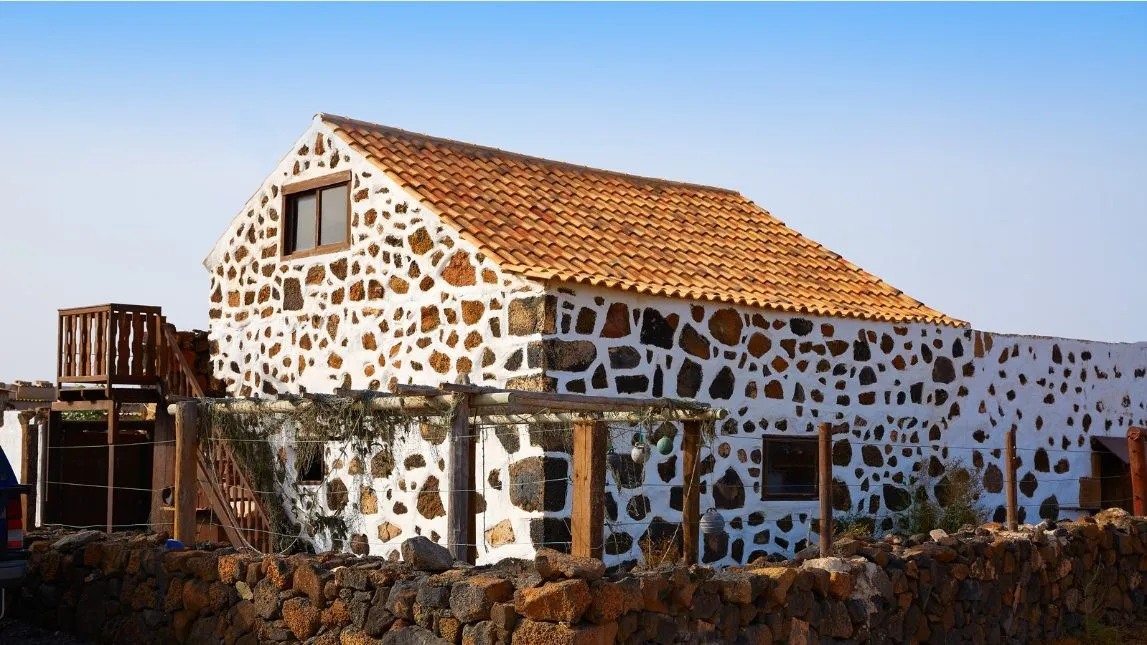
We’ll add our own photos of Lajares after our next visit. Until then, the main image is a licensed picture.
Beaches near Lajares
For a swim, you drive from Lajares to the coast. The nearest beaches are in El Cotillo to the west, less than ten minutes by car. Playa de la Concha there is sheltered by rocks just offshore and has a Blue Flag for 2026.
To the north is Majanicho, a small, quiet fishing village on the coast, with no restaurant and no facilities on the beach. A dirt track runs along the coast between Corralejo and El Cotillo. Whether you’re allowed to take a hire car on dirt tracks depends on your hire agreement. Our hire company, Cabrera Medina, doesn’t allow it with any of its cars, not even the Jeep, and if you do, you pay for any damage to the underbody yourself. The bay at Majanicho is a spot for surfers, windsurfers and wing foilers, not a swimming beach. On calm days you can snorkel there. Between Majanicho and Corralejo you’ll also find Popcorn Beach, with its pale calcareous algae that look like popcorn. Please leave them where they are: taking them is prohibited, and La Oliva council warns of fines of up to €3,000.
The big sandy beaches in the dunes nature park start just beyond Corralejo. It’s about 13 kilometres to Corralejo, a good quarter of an hour’s drive.
Calderón Hondo: looking down into the crater
Calderón Hondo is one of the best-known walks in the north. We’ve been up too: we parked nearby and then went up on foot. The path starts on the edge of Lajares: turn off at the roundabout towards Majanicho, and after about a kilometre you reach the walkers’ car park. The circular route is just under five kilometres long and leads through the lava fields up to the crater.
At the top, at 278 metres, there’s a viewpoint right on the crater rim. From there you look about 70 metres down into the crater, and the view stretches across the north coast to the island of Lobos and over to Lanzarote. Allow about an hour and a half for the loop; most people will manage it without difficulty. Please don’t feed wild animals such as the squirrels at the crater.
If you like, you can also walk round the crater on a path of just over a kilometre. Keep well back from the edge. Take water, sun protection and a windproof jacket – there’s often a strong wind in the north.
The names of the volcanoes are easy to mix up. Very close by, nearer to Corralejo, is Bayuyo, which we climbed in 2023. A signposted footpath leads to it from Lajares as well.
Food, cafés and shopping
Lajares is all about its small cafés, bakeries and shops. Most are on the main street that runs through the village. The mood is young and relaxed, with a surfer vibe, plus a few restaurants for the evening.
Our tip is El Goloso (Pastelería El Goloso de Lajares) on Calle Coronel González del Yerro, a café and patisserie with cakes and pastries made on the premises. The best seats are upstairs on the roof terrace: a coffee, something sweet, and village life passing by below. We’ve sat there ourselves, and it’s exactly the kind of thing we love: stopping at a café somewhere in the morning for a coffee and a pastry. Simple, cosy and somehow special – that’s Lajares all over.
Other places in the village, from our research and not yet tried by us:
- Los Pinchitos on Calle Coronel González del Yerro, traditional cooking
- La Boqueria on Calle Coronel Latherta González Hierro, international cooking
- Nuestro Estilo Empanadas on Calle Majanicho, freshly filled pastries for a snack
Every Saturday from 10am to 2pm there’s a small craft market with jewellery, ceramics, natural cosmetics and clothes, often with live music. It brings the village to life without Lajares losing its easy-going character.
In June Lajares celebrates its patron saint with the Fiestas de San Antonio de Padua: a good week with a procession, lucha canaria (Canarian wrestling), a craft market, an animal show, children’s activities and music in the streets. Entry is free; the council announces the exact dates each year.
For a big shop, the supermarkets in Corralejo and El Cotillo are the better choice; in the village itself the selection is limited.
Weather and sea temperature through the year
This is what the year looks like on average: day, night and sea, month by month. Air temperatures are measured by the weather station at the airport; the sea figures apply off Corralejo on the north coast. Our guide Best time to visit Fuerteventura covers which month suits you.
Tap a month to see all figures
| Month | Day (average high), °C | Night (average low), °C | Sea, °C | Sunshine (hours per day) | Rainy days (≥ 1 mm) |
|---|---|---|---|---|---|
| January | 20.8 | 14.9 | 18.9 | 6.3 | 2.3 |
| February | 21.1 | 14.9 | 18.3 | 6.8 | 1.9 |
| March | 22.3 | 15.5 | 18.3 | 7.7 | 1.8 |
| April | 23.2 | 16.4 | 18.8 | 8.3 | 0.8 |
| May | 24.7 | 17.7 | 19.7 | 9.2 | 0.2 |
| June | 26.3 | 19.5 | 20.9 | 9.5 | 0.0 |
| July | 27.5 | 21.1 | 21.7 | 9.8 | 0.0 |
| August | 27.9 | 21.9 | 22.5 | 9.4 | 0.1 |
| September | 27.5 | 21.5 | 23.0 | 8.7 | 0.5 |
| October | 26.4 | 20.2 | 22.8 | 7.3 | 1.8 |
| November | 24.2 | 18.0 | 21.5 | 6.5 | 2.1 |
| December | 22.1 | 16.1 | 20.0 | 6.2 | 2.6 |
Air: © AEMET, climate normals 1991–2020, Fuerteventura Aeropuerto station · Sea temperature: Copernicus Marine Service (EU) – Generated using E.U. Copernicus Marine Service Information, monthly means 1991–2020
Practical tips: getting there, wind, accommodation
Without a hire car, Lajares is hard work. Bus line 8 between Corralejo and El Cotillo stops in the village; current timetables are on tiadhe.com. For the beach, walks and shopping, though, a hire car gives you far more freedom. A taxi from the airport runs on the meter; there are no fixed prices.
Inland it’s often a little cooler and windier than on the hotel beaches in the south. You’ll need a jacket in the evening.
You can stay in holiday homes, small apartments and surf accommodation; there are no big hotels here.
From our research (we haven’t stayed here ourselves): in and around the village there are plenty of casas rurales (country houses) and holiday flats. If you’d rather stay in a small hotel, the neighbouring village of Villaverde has the Hotel Rural Mahoh: a house dating from before 1900 with nine rooms, a restaurant and a pool. Some surf schools in the village, such as Magma School, also offer accommodation for people on their courses.
Surfing, kitesurfing and mountain biking from Lajares
Lajares is a good base if you like to be active. One example, from our research: Magma School at Calle Redonda 1 offers surf courses lasting one to five days, kitesurfing from age 12, stand-up paddleboarding and guided mountain bike tours, for example to Corralejo, Tindaya and Calderón Hondo. Equipment is included with the courses. It’s worth comparing several schools in the village before you book.
Day trips from Lajares
Lajares sits in the middle of the north, and almost everything is within a quarter of an hour. El Cotillo, with its lagoons, fishing harbour and sunsets, is to the west. Corralejo, with its harbour, promenade and the ferries to Lanzarote and Isla de Lobos, is to the east, with the dunes beyond. To the south is La Oliva with the Casa de los Coroneles, and the sacred mountain of Tindaya isn’t far. You’ll find all these places on our island map.
Around Lajares: places to see nearby
- La Oliva (about 9 km, just under 10 minutes): the Casa de los Coroneles is a 17th-century manor house with wooden balconies and towers for defence against pirates. It has been closed since March 2022, and no reopening date is known. Also in La Oliva, the Centro de Arte Canario shows Canarian art, including works by César Manrique, and has a large sculpture garden.
- Montaña de Tindaya (about 14 km, roughly 15 minutes): the sacred mountain of the island’s original inhabitants, with ancient rock engravings. It is a natural monument and an archaeological zone. You may only climb it with a permit from the Cabildo (island government). It’s still worth seeing from below.
- Ecomuseo La Alcogida in Tefía (about 22 km, a good 20 minutes): an open-air museum with seven restored houses, goats, donkeys and camels, and craftspeople demonstrating their work. Good with children too.
Lajares or El Cotillo: where to stay in the north?
In short: Lajares is the inland village, El Cotillo the fishing village by the sea. If you want to be by the water every morning, stay in El Cotillo. If you’re after cafés, village life and the surf spots in the north close by, Lajares is the right choice.
| What | Lajares | El Cotillo |
|---|---|---|
| Location | inland, no beach of its own | right by the sea |
| Swimming | El Cotillo’s beaches about ten minutes away by car | lagoons to the north; beaches to the south dangerous because of the waves |
| Atmosphere | village with surfers, artists, cafés | quiet, fishing village, surfers |
| Food and cafés | cafés and bakeries on the main street | eating at the harbour and at sunset |
| Markets | craft market on Saturdays | craft market on Friday evenings |
| Accommodation | holiday homes, apartments, surf accommodation | apartments, holiday homes |
We wouldn’t stay in Lajares ourselves: we’d miss the sea view and the walk by the water. But we’re always happy to sit in the village over a coffee and a slice of cake.
Who is Lajares for – and who isn’t it for?
Lajares suits you if you surf, kitesurf, walk or simply want a village rather than a hotel zone. The atmosphere is relaxed and low-key, and the spots in the north are close by.
It’s less suitable if you want to walk to the beach in the morning or are travelling without a car. Families looking for hotel, pool and beach all in one place are also better off in Corralejo or Caleta de Fuste.
We wouldn’t stay here ourselves. Being in the middle of the village isn’t for us; we’d miss the sea view and the walk by the water. For us, that’s simply part of relaxing.
