

What kind of place is Caleta de Fuste?
Caleta de Fuste is a resort on the east coast, built up around a small bay that opens to the south. It belongs to the municipality of Antigua and lies only about eight kilometres south of the airport – no other resort on the island is closer. In brochures and on signs it’s often called El Castillo, sometimes Costa Caleta. It’s always the same place.
The place owes its name to the harbour and the tower. In the 18th century the big landowners of Antigua shipped their goods from here to the neighbouring islands. To protect against pirates, a round defensive tower of natural stone was built in 1743 – the Castillo de San Buenaventura. There’s a similar tower in El Cotillo in the north-west. The resort itself only took shape from around 1980, first with bungalows around the old tower, then growing year by year.
That’s why there’s no historic centre. Instead you’ll find bungalow complexes set in plenty of greenery, hotels, several shopping centres, and the harbour as the place where people meet. Over the last two decades a newer district has been added on the southern edge, with larger hotels, two golf courses and another beach. Traditionally, the visitors are largely British.
There’s a lot more going on here than in the south – plenty of places to eat and drink, lots of shops. That’s no bad thing, quite the opposite. Caleta de Fuste is a cosy little place where you can have a really lovely holiday as a family or a couple – and where you could happily live, too, especially for longer stays and for spending the winter. Everything close by, everything you need, and the airport round the corner.
Beaches in Caleta de Fuste: a sheltered bay for children, a promenade to the south
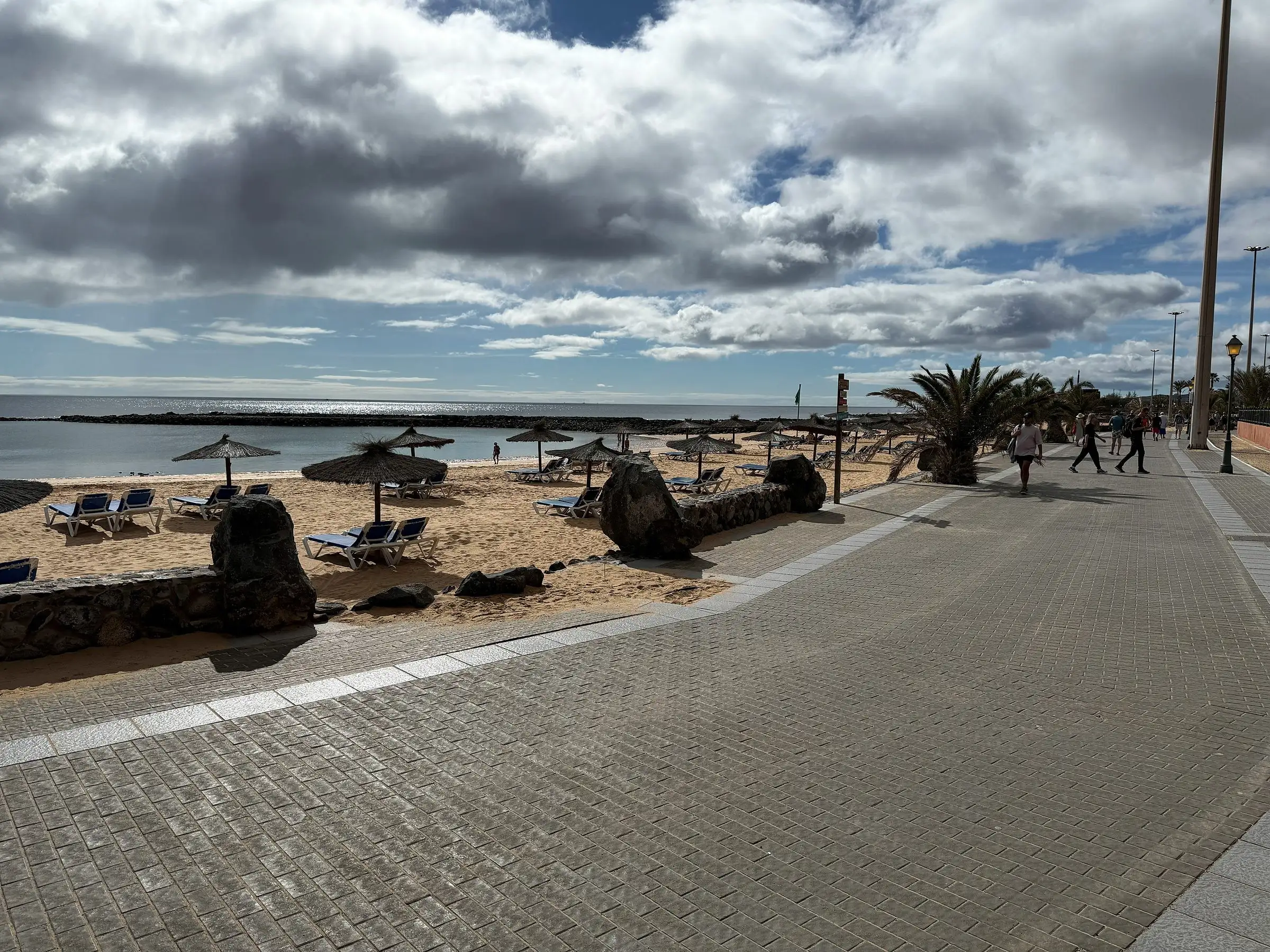
The main beach, Playa del Castillo, is a good beach for families. It lies in the bay, with pale, fine sand that shelves gently, and a harbour wall keeps out the Atlantic surf. The water is usually calm. Sunbeds, parasols, showers and beach bars are right on the sand.
Für Familien mit kleinen Kindern würden wir Caleta de Fuste sogar empfehlen.
For small children this is a more relaxed choice than the open beaches in the south: a sheltered bay, usually calm water that shelves gently, everything close by, places to play and loads of restaurants right on the doorstep. Even so, never let children out of your sight.

Worth knowing: Playa del Castillo used to have a Blue Flag, but in 2026 it doesn’t. That says nothing about danger – it just means the award wasn’t given this year.
To the south is Playa de La Guirra, an artificial beach added later in front of the newer hotel district. A wide promenade links the two beaches – easy on foot and almost flat.
The wind on the east coast is usually moderate, and the bay is sheltered. So there are no waves for surfing in the bay. The surf schools in town take beginners to other beaches, depending on the conditions on the day. For stand-up paddleboarders and children, though, the calm water is all the better. Personally, though, we miss the long, unspoilt beaches we love so much in the south.
The harbour and the castle
The hub of the resort is the small marina, the Puerto del Castillo. Big ferries don’t call here, but yachts, fishing boats and excursion boats do. Boat trips leave from the harbour, and all around it there are cafés, restaurants and water sports operators.

The Castillo de San Buenaventura stands right next to it, between the harbour and the beach. Today it sits in the middle of a hotel complex, but you can easily take a look at it from outside. It’s the landmark of Caleta de Fuste and the reason for the resort’s other name, El Castillo, “the castle”.
For us, the harbour and the Castillo are part of every visit. We stroll along the water, watch the boats, sit down somewhere for a coffee or a bite to eat, and just look out to sea. We’ve never actually done a boat trip in Caleta itself, though there are plenty on offer. Our boat trips were in Morro Jable – a catamaran trip and an ordinary boat trip from the harbour.
Things to do in Caleta de Fuste: diving, golf, the promenade
The calm bay makes it easy to get started. If you want to try water sports, you’ll find shallow, usually calm water here and the operators right at the harbour. We haven’t tried them ourselves – the information comes from our research.
Diving and snorkelling: The Deep Blue dive centre is based in the harbour. It offers taster dives for beginners and guided snorkelling trips. The boats are moored right next door, so there are no long journeys out to the dive sites. Birgit and I find diving really exciting. We wanted to try it last time, and now it’s firmly on the list for our next holiday.
Golf: On the southern edge of the resort there are two 18-hole courses right next to each other, the Fuerteventura Golf Club and the Golf Club Salinas de Antigua. Several golf hotels surround them, and it’s only a few steps from your room to the tee.
Walking by the sea: The promenade runs north and south from the resort. To the south it turns into the wide coastal path to Las Salinas – more on that below under day trips.
Der kleine Hafen und das Castillo gefallen uns nach wie vor, dort sitzen wir gerne und genießen die Atmosphäre.
Eating out, shopping and evenings
The food here is mostly international, and what’s on offer is geared to holidaymakers. You’ll find restaurants and bars at the harbour, along the promenade and in the shopping centres, the Centros Comerciales. The best known is the Castillo Centro, with its courtyard in the style of an Andalusian country estate; in the newer southern part there’s the Atlántico shopping centre.
One tip from us is La Frasquita, right on the beach with a view of the sea. It serves fresh fish and typical Canarian dishes. The nice part: you choose your fish of the day straight from the display.
For a coffee break, the cafés at the harbour are the nicest spot, looking out over the yachts and fishing boats. In the Castillo Centro, with its shady courtyard, you’ll find more restaurants and bars.
Fish by the water: In the fishing village of Las Salinas, about two kilometres south, there’s the fish restaurant Los Caracolitos, and there’s also a restaurant at the salt museum. It fits in nicely with a walk along the coastal path.
There are several supermarkets in the resort. Evenings are on the relaxed side, with pubs, bars and live music in the hotels. Caleta de Fuste isn’t a party town like Corralejo.
Markets and festivals
Weekly market: On Avenida Alcalde Juan Ramón Soto Morales there’s a mercadillo (weekly market) selling clothes, bags, jewellery and souvenirs. More colourful than local, but nice for a wander. The tourist information office or your hotel is the best place to find out the current market days.
Festivals: The biggest festival in the resort is held in honour of the Virgen de la Peña del Mar, with a Mass, a boat procession through the harbour, fireworks over the sea and dancing in the evening, usually in September; the exact dates change from year to year. In neighbouring Las Salinas, the fishermen celebrate their patron saint, the Virgen del Carmen, in summer.
Where to stay in Caleta de Fuste
We’ve never stayed in Caleta de Fuste ourselves. This overview is based on our research, not on our own experience. It’s meant to help you find the location that suits you.
Right on the bay: The large Barceló Fuerteventura Castillo bungalow complex is set around the Castillo, opposite Playa del Castillo and only about 150 metres from the marina. It has family suites and a separate adults-only area. In the resort, you can hardly stay any closer to the beach and harbour.
In the newer south and by the golf courses: This is where the bigger hotels are. The Elba hotels Sara and Carlota are by the sea, between gardens and golf courses, and are expressly aimed at families. The Elba Palace Golf, right between the courses, only takes guests aged 16 and over. The Sheraton Fuerteventura Beach, Golf & Spa Resort is also in Caleta de Fuste.
Apartments and bungalows: In between there are many smaller apartment and bungalow complexes set in spacious gardens, often with a pool. For longer stays and for spending the winter they’re usually the more flexible choice.
Caleta de Fuste weather and sea temperature through the year
This is what the year looks like on average – day, night and sea, month by month. Air temperatures come from the weather station at the airport; the sea figures are for the waters off Sotavento in the south. To work out which month suits you, see our guide Best time to visit Fuerteventura.
Tap a month to see all figures
| Month | Day (average high), °C | Night (average low), °C | Sea, °C | Sunshine (hours per day) | Rainy days (≥ 1 mm) |
|---|---|---|---|---|---|
| January | 20.8 | 14.9 | 19.0 | 6.3 | 2.3 |
| February | 21.1 | 14.9 | 18.4 | 6.8 | 1.9 |
| March | 22.3 | 15.5 | 18.5 | 7.7 | 1.8 |
| April | 23.2 | 16.4 | 19.0 | 8.3 | 0.8 |
| May | 24.7 | 17.7 | 19.8 | 9.2 | 0.2 |
| June | 26.3 | 19.5 | 21.0 | 9.5 | 0.0 |
| July | 27.5 | 21.1 | 21.9 | 9.8 | 0.0 |
| August | 27.9 | 21.9 | 22.7 | 9.4 | 0.1 |
| September | 27.5 | 21.5 | 23.1 | 8.7 | 0.5 |
| October | 26.4 | 20.2 | 22.9 | 7.3 | 1.8 |
| November | 24.2 | 18.0 | 21.8 | 6.5 | 2.1 |
| December | 22.1 | 16.1 | 20.2 | 6.2 | 2.6 |
Air: © AEMET, climate normals 1991–2020, Fuerteventura Aeropuerto station · Sea temperature: Copernicus Marine Service (EU) – Generated using E.U. Copernicus Marine Service Information, monthly means 1991–2020
Practical information: getting there, buses, taxis, aircraft noise
From the airport you’re in the resort in about ten minutes, heading south on the FV-2. Without a car, take Route 3 of the TIADHE island buses (in the Canaries, buses are called guaguas). Route 10 heading south also stops at the Castillo. Current times are on tiadhe.com.
A metered taxi from the airport costs about €30, a little more at night, on Sundays and on public holidays. There are no fixed fares. If you want to explore the island, you can hardly do without a hire car. For a pure beach holiday in the bay, you don’t need one.
Almost everything in the resort itself is within walking distance. There are doctors, pharmacies (farmacia), banks and cash machines in town.
An honest word about aircraft noise: The airport is only a few kilometres away, and you’ll see and hear the planes regularly. On our day trips it didn’t bother us. Two weeks’ holiday right here might be a different matter for us, though. How much you notice it depends on where your accommodation is and on the wind. If you’re looking for complete peace and quiet, you’re better off staying further away from the airport.
Day trips from Caleta de Fuste
Caleta de Fuste is right in the middle of the east coast, so the north and south of the island are equally easy to reach. These places are close by:

Coastal path to Las Salinas
A lovely, flat coastal path runs south – the Sendero de La Guirra. It starts at the promenade, passes old lime kilns and then crosses empty, level country to the fishing village of Las Salinas. That’s where you’ll find the Salinas del Carmen, a salt works still producing sea salt, with a salt museum. There and back takes a few hours, and you can also come back by bus. Take water and sun protection – there’s no shade along the way.

Salinas del Carmen and the salt museum
About 2 km south, sea salt is still produced today in old salt pans dating from the early 20th century. In the Museo de la Sal (salt museum) a tour shows you how seawater turns into salt, and you can take some home from the shop.
Pozo Negro and the indigenous village of La Atalayita
About 7 km south as the crow flies, the small fishing village of Pozo Negro sits at the end of a valley, with a dark beach. In the valley just before it is La Atalayita, an archaeological site of the Majos, the island’s original inhabitants, with the remains of many buildings and a small exhibition. A quiet half-day trip by car.
Antigua: windmill and cheese museum
About 15 km inland as the crow flies, you come to Antigua. An 18th-century windmill houses the island’s cheese museum, with a garden and shop. Make sure you try the queso majorero (the island’s goat’s cheese) there.
Tiscamanita: windmills and gofio
About 17 km away as the crow flies, the Tiscamanita windmill museum shows how grain was grown on the island and ground into gofio (toasted flour). A good outing with children, too.
Betancuria, the old capital
About 19 km as the crow flies, a bit further by road over the mountains – Betancuria is the old heart of the island, with its church, narrow streets and viewpoints on the way there.
Puerto del Rosario
About 13 km north is the island’s capital, Puerto del Rosario, with its harbour promenade, sculptures and shopping streets. Route 3 gets you there without a car, too.
Corralejo in the north and Costa Calma in the south both make easy day trips. You’ll find all these places on our island map.
Caleta de Fuste or Corralejo: which suits you?
Caleta de Fuste is the compact family resort in the middle of the island, Corralejo the lively town in the north. Which one suits you depends on what you’re looking for: Caleta de Fuste has its sheltered bay and everything close by going for it, Corralejo its dunes, old town and ferries. We like coming to Caleta de Fuste for a stroll and a meal.
| What | Caleta de Fuste | Corralejo |
|---|---|---|
| Location | East coast, middle of the island | North |
| Airport | approx. 10 minutes | approx. 35 minutes |
| Beach | sheltered bay, calm and shallow | town beaches, big dune beaches outside town |
| With small children | very good | good on the town beach |
| Aircraft | seen and heard regularly | hardly |
| Evenings | Pubs, bars, hotels | Bars, music, old town |
| Day trips | North and south equally close, the interior | Lobos, Lanzarote, dunes |
| Longer stays, spending the winter | very good, everything on hand | good, lively |
What we don’t like
Honestly, it’s a matter of taste. For us personally, parts of Caleta de Fuste are too densely built up, and because it’s so close to the airport, you notice the planes again and again. There’s no historic centre. If you like having everything on your doorstep, you’ll see exactly that as an advantage.
Then and now
When we walk through Caleta de Fuste today, it barely compares with the place it was in 1996. The small, manageable resort has grown into a proper town where people holiday and live. Sometimes we miss a bit of the original charm, but we like the harbour and the Castillo as much as ever.
| What | 1996 | Today |
|---|---|---|
| Resort | much smaller in scale | lots of hotels, complexes, shops and restaurants |
| Atmosphere | quieter, more original charm | more tourist bustle |
| Harbour and Castillo | a meeting place by the water | we still like them |
| For us | Day-trip destination | Day-trip destination, but we prefer Costa Calma for holidays |
