

Location and history
Costa Calma is in the south of Fuerteventura, right where the Jandía peninsula begins. It belongs to the municipality of Pájara and, together with the Cañada del Río development, has around 5,600 inhabitants. The name means “calm coast”.
There is no historic centre; Costa Calma was planned on the drawing board. Its story begins with a German: Gustav Winter, the man behind the Villa Winter near Cofete, for a long time held the lease on almost the whole of the Jandía peninsula, which was then virtually uninhabited. Costa Calma came into being as a holiday resort in the 1970s, and the Cañada del Río development was added in the 1980s. After that, hotels and apartment complexes went up year after year.
The resort sits on the Istmo de La Pared, the narrowest part of the island, only about five to six kilometres wide. The isthmus takes its name from a wall (pared): the island’s original inhabitants are said to have used it to separate two kingdoms, though there is hardly any firm evidence for that. Here the trade wind drives the sand from the west coast right across the isthmus to the south, which is why you see so many pale dunes around Costa Calma. A large part of this is a protected area for birds, and the Jandía Natural Park begins just to the south.
What strikes you the moment you arrive is the greenery. El Palmeral, a wide green belt with around 7,000 palm trees, runs right through the middle of the resort. It separates the hotel district by the beach from the residential area inland. Lots of people jog and stroll on the wide paths alongside it.
And yet the place has a character I find hard to put into words. I know every town and village on the island; I’ve been everywhere. But there’s nowhere I’d rather stay. To be honest, I never gave anywhere else a real chance either. That’s just how I am.

What makes the place for us: it’s quiet, and you can reach almost everything on foot. Restaurants, supermarkets, the beach. We always have a hire car, but in Costa Calma it mostly stays parked. We only use it for the big shop and for trips to other parts of the island.
The beaches: from the resort to Sotavento
The main beach, Playa de Costa Calma, is a good one and a half kilometres long, with pale sand and a gentle slope into the water, and has sunloungers, parasols, showers, toilets and beach bars. In 2026 it holds the Blue Flag, an award for water quality, safety and services that is awarded afresh every year. The northern section is covered by the lifeguard service of the municipality of Pájara. The information board at the entrance to the beach shows when the lifeguard posts are staffed. The waves are mostly moderate, which makes it a good beach for families.

Each stretch has its own appeal. The near end is busier, and you can stop at a bar for something to eat or drink in between. The further south you go, the quieter it gets.
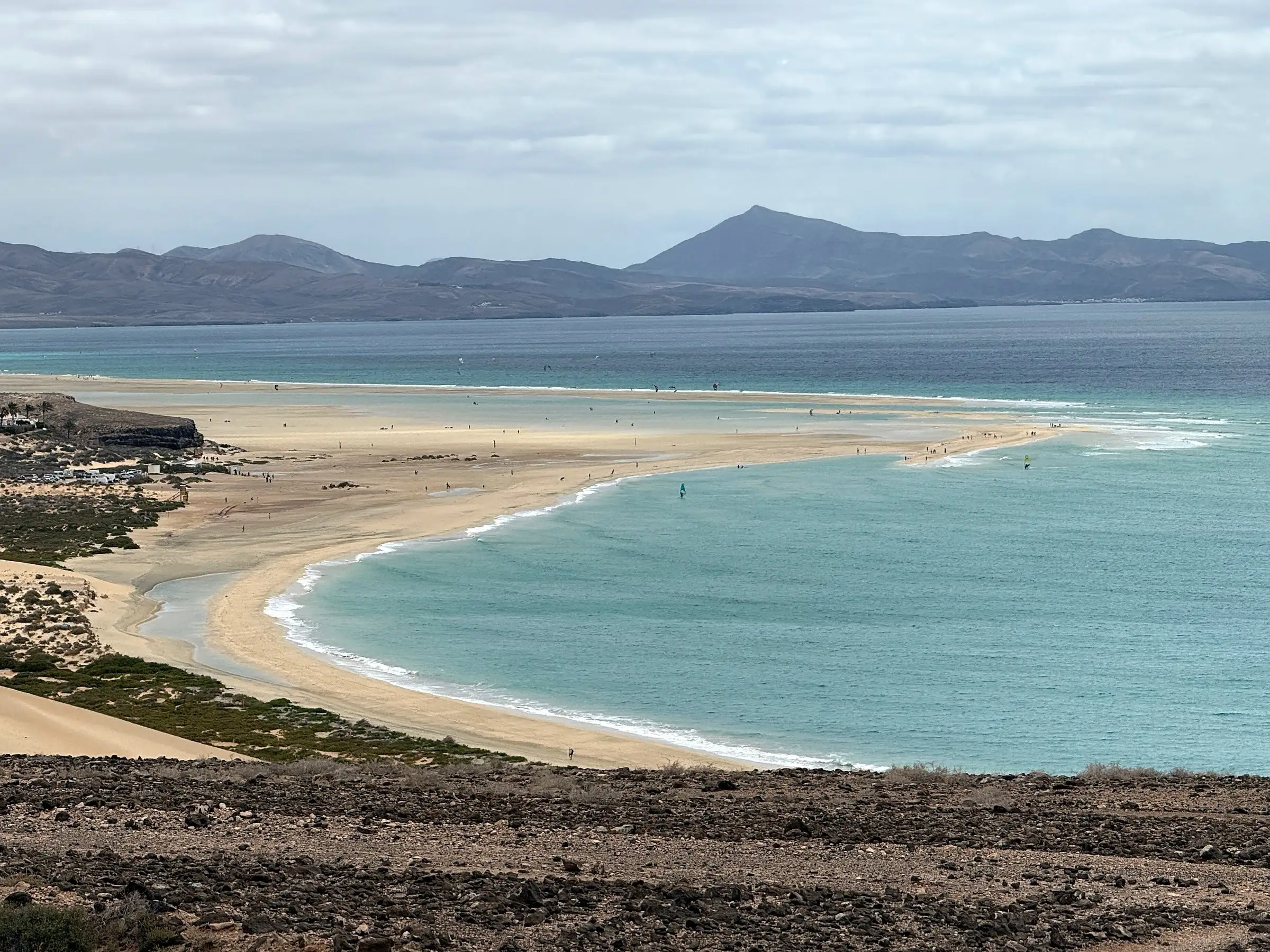
To the south comes the smaller Playa Esmeralda, and after that the Playas de Sotavento begin, running with few breaks all the way to Morro Jable. About two kilometres south of the resort is Playa Barca: here a narrow spit of sand around four kilometres long separates a shallow lagoon from the open sea. On the quieter stretches, naturism is tolerated in many places. The far end, including the beach below the Hotel Paradisus (formerly the Meliá), is for me the most beautiful beach of all. The space, the quiet, the pale sand, the turquoise water. We’ve spent countless hours there. It doesn’t get any more peaceful than this, and there’s nowhere better to clear your head.
The Sotavento lagoon
At high tide it fills up behind the sand spit; at low tide it largely drains and turns into tidal flats. There are no waves like you get on the open sea, most of it is shallow, and for swimmers the lagoon is undemanding. The danger is being caught by surprise: the channels the water flows in through are deeper than the rest. You’re wading through shallow water and, whoosh, you’re in up to your chest. That’s what happened to my sister, fully clothed. The water comes in fast on the rising tide, so never take your eyes off children. The sand spit itself is sometimes washed over at high water too, so don’t leave your things too close to the water. Keep an eye on the tides.
My tip: Don’t stay put in one corner. Walk along the beach, from the top end of Costa Calma to the surf centre. We do that several times every holiday.
Sotavento: windsurfing and kitesurfing territory
Sotavento is Spanish for “leeward side”, meaning the side that faces away from the wind. For surfers the name is almost a joke: the trade wind often blows strong and steady across the lagoon here. That is exactly what has made Sotavento known to windsurfers and kitesurfers around the world.

The Windsurfing World Cup has been held here since 1986. It was brought here by René Egli, who is Swiss; his surf centre still stands on the beach below the Paradisus today. 2026 saw the 38th edition, from 17 July to 1 August, with windsurf freestyle, slalom and wingfoil. Beginners practise in the sheltered lagoon at high tide, while experienced riders head out onto the open sea, often in strong wind. The best view over the whole lagoon is from the viewpoint at Risco del Paso, a little further south, where a huge shifting dune towers up.
Down in front of the Paradisus you’ll almost always see kitesurfers. Even if you don’t surf yourself, sitting on the beach and watching is part of every holiday for us.
Costa Calma market: Wednesdays and Sundays
There’s a market in Costa Calma on Wednesdays and Sundays, from 9am to 2pm in Calle Hapag-Lloyd, near the police station. Many people call it the African market.
We walk there and enjoy wandering round the market. It’s always very busy. Here and there you’ll find handicrafts that I think are really great. Some traders will also offer you a massage. I haven’t really found them pushy.

Fiestas and other markets nearby
On Sundays the market at Oasis Wildlife in La Lajita, a few minutes to the north, is worth a visit: more than 80 stalls with crafts, fruit and vegetables from the island and traditional pastries.
In July there’s more going on in the area than at any other time. On 2 July the municipality of Pájara celebrates its patron saint, the Virgen de Regla, and on 16 July Morro Jable follows with the Virgen del Carmen, the patron saint of fishermen, with a procession at sea. Then from mid-July the Windsurfing World Cup comes to Sotavento.
Eating out and shopping: where we’ve been going since 1996
In place of a town centre there are several small shopping centres, the Centros Comerciales, with shops, cafés and restaurants, spread across the whole resort. Then there are the restaurants in the hotels. The choice is international. There’s hardly any nightlife; evenings are laid-back.
We’ve been eating at Mamma Mia since 1996. It was the first restaurant I ate at on the island, and it’s still our regular haunt today. I’ve watched the son grow up over the years; the father no longer works in the kitchen these days. To the family there, we’re no doubt tourists like many others; to us it’s a piece of home. The cooking covers everything we like.
In the same building is Al Fresco, where the food is really good too. And now and then we like to go to Pizzeria Hawaii: honest food at a low price, and it’s been there since my first years here.
We buy odds and ends at one of the two SPAR shops in the resort; one of them is new and really nicely laid out. For the big shop we drive to Lidl. We always stop there on the way from the airport anyway.
For lunch we now often put something together ourselves: a few tapas, melon, olives, cheese. You don’t need more than that in the heat. And for afterwards there’s a small ice-cream parlour in the resort run by Germans. The ice cream is very good.
We go to Café Berlin in Calle Sicasumbre quite spontaneously, with no plan, as the mood takes us, sometimes in the morning, sometimes in the afternoon. It’s a German bakery with a café in the Botánico shopping centre (C.C. Botánico), not far from our new favourite hotel. In the same centre is the HiperDino Express Botánico supermarket, which the chain says is open daily from 8am to 10pm. We’re thoroughly German about it: coffee, a slice of cake or a filled roll. In the Botánico you’ll also find one of the Fuerte Action shops, which everyone on the island knows and of which Costa Calma has several, and a fish spa.
Is Costa Calma expensive?
Of course it’s got more expensive over 30 years. The people who live there have to make a living too. When Birgit and I really go to town on a meal out, with a carafe of wine, a beer, steak for me, fish for Birgit, Gambas al Ajillo (prawns in garlic oil) as an extra course and dessert, the bill can come to €70. But we’ve only managed that once. Otherwise the two of us usually come in at just under €50.


As a guide, according to the menu at Mamma Mia in May 2026: pizzas start at about €6, and most fish and meat dishes are between around €10 and €19. One thing many people only notice when the bill arrives: lots of menus say “la guarnición se paga aparte”. That means the side dish costs extra; at Mamma Mia it’s €1.90.
Supermarket prices are reasonable, but higher than at Lidl. That’s why we only pick up odds and ends in the resort. If you keep your eyes open a bit, you’ll get by fine in Costa Calma. And I’m happy to give something back to the island. The people there aren’t as well off as some holidaymakers think.
Weather and sea temperature through the year
This is what the year looks like on average: day, night and sea, month by month. Air temperature is measured by the weather station at the airport; the sea figures apply off Sotavento in the south. Our guide to the best time to visit Fuerteventura tells you which month will suit you.
Tap a month to see all figures
| Month | Day (average high), °C | Night (average low), °C | Sea, °C | Sunshine (hours per day) | Rainy days (≥ 1 mm) |
|---|---|---|---|---|---|
| January | 20.8 | 14.9 | 19.0 | 6.3 | 2.3 |
| February | 21.1 | 14.9 | 18.4 | 6.8 | 1.9 |
| March | 22.3 | 15.5 | 18.5 | 7.7 | 1.8 |
| April | 23.2 | 16.4 | 19.0 | 8.3 | 0.8 |
| May | 24.7 | 17.7 | 19.8 | 9.2 | 0.2 |
| June | 26.3 | 19.5 | 21.0 | 9.5 | 0.0 |
| July | 27.5 | 21.1 | 21.9 | 9.8 | 0.0 |
| August | 27.9 | 21.9 | 22.7 | 9.4 | 0.1 |
| September | 27.5 | 21.5 | 23.1 | 8.7 | 0.5 |
| October | 26.4 | 20.2 | 22.9 | 7.3 | 1.8 |
| November | 24.2 | 18.0 | 21.8 | 6.5 | 2.1 |
| December | 22.1 | 16.1 | 20.2 | 6.2 | 2.6 |
Air: © AEMET, climate normals 1991–2020, Fuerteventura Aeropuerto station · Sea temperature: Copernicus Marine Service (EU) – Generated using E.U. Copernicus Marine Service Information, monthly means 1991–2020
Practicalities: bus, taxi, parking
From the airport, it’s about an hour by hire car heading south on the FV-2, around 62 kilometres. Without a car, take the number 10 bus run by the island bus company TIADHE (in the Canaries buses are called “guaguas”); it goes from the airport via Costa Calma to Morro Jable. Route 5 also shuttles between Costa Calma and Morro Jable via the hotel zones. Current times are on tiadhe.com.
A taxi from the airport costs about €90 to €95 on the meter, and more at night, on Sundays and on public holidays. There are no fixed prices. The official taxi rank is in the airport’s arrivals area.
Parking has become a problem. There are far more cars around than there used to be. That’s another reason we do almost everything in the resort on foot.
Everyday needs are covered: the resort has doctors’ surgeries where German or English is spoken, and some are even entirely German-run. There are also pharmacies (“farmacia”), banks and cash machines. In the Botánico, at Avenida Jahn Reisen 37, the Deutsche Klinik CENMED has a practice, telephone 928 875 654. According to the sign, health insurance is accepted; check beforehand whether that includes yours.
Where to stay in Costa Calma: which area is best?
Location matters more than the hotel. Costa Calma stretches a long way along the coast, and your holiday will look different depending on where you stay.
In the middle of the resort you’re close to the main beach, the Palmeral and the shopping centres. Restaurants, a supermarket and the market are within walking distance, and the car can stay where it is.
Towards Sotavento in the south there are large complexes right on the long beach. You get more space and quiet there, but you’ll usually need a car or the bus to get to places to eat in the resort.
Where we’ve stayed ourselves: Over the years we’ve been in a lot of hotels: the Club Green Oasis, the Barlovento, the Costa Calma Palace and the R2 Pájara Beach. In 2023 we spent two weeks all-inclusive at what was then the Meliá, now the Paradisus, before the refurbishment: a wonderful, venerable old place. Our new favourite hotel is the Esmeralda Maris by LIVVO, just a few steps from the R2 Pájara Beach. Each of these hotels will get its own review later on.
Based on our research – so not places we’ve tried ourselves – these hotels also suit particular needs:
SBH Costa Calma Beach Resort: Four-star all-inclusive hotel right on the promenade at the start of Costa Calma beach, with several pools and kids’ clubs. Good for families who want everything within walking distance.
H10 Tindaya: All-inclusive complex with direct access to Sotavento beach, a children’s programme for 4- to 12-year-olds and its own water play area. Good for families who’d rather stay on the long beach than in the middle of the resort.
Paradisus Fuerteventura: The former Meliá on Sotavento beach was refurbished for €32 million and opened in October 2025 as an all-inclusive luxury hotel. René Egli’s surf centre is directly below it.
On top of that, there are holiday flats and smaller apartment complexes all over the resort, ideal if you want to self-cater.
Walks in and around the resort
Take the time to explore the whole resort. Every corner has its own charm. We like to amble through the resort and walk back along the beach. The exercise does you good there.
Walk up one of the hills behind the resort some time, too. From the top you can see the whole of Costa Calma, the long beach and as far as Sotavento. And do have a look at other hotels as well. You might just find the perfect hotel for your next holiday.
A lovely walk leads right across the isthmus to the west coast: you follow the white wind turbines all the way, and with breaks you’ll be out for about two hours there and back. You can’t get more peace than this: sit down and just look out to sea. Along the way you’re in the middle of nowhere, so always take enough water, a few snacks and something to cover your head.
Westküste ist immer Pflicht zu Fuß.
Around Costa Calma: places worth visiting nearby
From Costa Calma you can be on two very different coasts within a quarter of an hour: the calm lagoon in front, the wild west coast behind. These places are worth the trip, from a short detour to a full day out.
La Pared and Playa del Viejo Rey (around 9 kilometres, about 8 minutes by car): on the other side of the isthmus the Atlantic rolls in unchecked. Lots of people surf here, and in the evening people come for the sunset. This beach is dangerous for swimming. Better to watch the waves from above, and bring a jacket – it’s very windy by the water.
Mirador Astronómico de Sicasumbre (on the road from La Pared to Pájara): a viewpoint at around 300 metres, set up for stargazing, with spots for cameras and telescopes. Because there’s hardly any light around to interfere, the night sky is particularly clear here. By day you look out far across the barren hills. Bring something warm for the evening.
Oasis Wildlife in La Lajita (a good 8 kilometres, about 8 minutes): a zoo with giraffes, elephants, lemurs, sea lions and parrots, plus a large botanical garden. There’s a market there on Sundays. A good outing with children, especially on windy days.
Pájara (around 31 kilometres, about 25 minutes): the main town of the municipality sits among greenery in the island’s interior. The 17th-century church of Nuestra Señora de Regla is worth seeing: its façade is decorated with animal motifs modelled on Aztec designs. Inside, look up at the carved wooden ceiling.
Ajuy caves (via Pájara to the west coast): this natural monument has the oldest rocks in the Canaries, more than 100 million years old according to the Cabildo (the island government). A path leads along the coast to the large caves, and access is free. When the sea is rough, the municipality closes the path, so please respect the barrier. Wear sturdy shoes; the route goes over steps and rock.
Morro Jable and Jandía (about 20 minutes): a long promenade with fish restaurants, the lighthouse right in the middle of the beach, the turtle centre and the harbour, where the ferries to Gran Canaria leave from.
Cofete and the Villa Winter: the only way from Morro Jable to the endless beach on the north-west coast of Jandía is a gravel track. Whether you’re allowed to take a hire car on tracks depends on your hire agreement. With our hire company, Cabrera Medina, it isn’t allowed in any car, not even a Jeep, and you then pay for any damage to the underside of the car yourself. The alternative is bus route 111 from Morro Jable, around 55 minutes according to the timetable. Cofete is not suitable for swimming; the beach is considered extremely dangerous and has no lifeguards.
You’ll find all these places on our island map too.
Things to do in Costa Calma: activities and experiences
Windsurfing, kitesurfing and wingfoiling: René Egli’s centre has been on Sotavento beach by the Hotel Paradisus since 1984, with lessons and equipment hire for all three sports. Matas Bay, on Matas Blancas beach just a few minutes’ drive north of the resort, is smaller. It also offers lessons and hire, and people on courses are picked up free of charge in Costa Calma, Morro Jable and La Pared.
Golf: The nearest course is Jandía Golf near Morro Jable, an 18-hole course in a hollow between the hills at the Barranco de Vinamar.
Buggy tours: Guided buggy trips from Costa Calma into the hills are offered through activity booking sites. Only drive routes like these with a guide, not on your own in a hire car.
Walking: The walk across the isthmus to the west coast starts right behind the resort. More strenuous is the climb up Pico de la Zarza near Morro Jable, the highest mountain on the island.
With children: the gently shelving main beach, the shallow edges of the Sotavento lagoon, always with one eye on the children, and a day at Oasis Wildlife. On Matas Blancas beach, Matas Bay has a shaded area for children and lifeguards on site.
Costa Calma or Jandía?
Both places have their charm, but they’re very different.
Jandía simply has more going on. There’s somewhere to stop for a drink or a bite everywhere, there are people selling things everywhere, much of it is built up, and the resort merges straight into Morro Jable. The promenade towards Morro Jable, with its fish restaurants and shops, is a dream. If you want a bit of bustle and something to do in the evening, that’s the place for you. On the other hand, there are next to no parking spaces. If you’re coming by car, you need to get there early.
Costa Calma is the place for winding down, relaxing, thinking. This is how I do it: I stay in Costa Calma and enjoy driving over to Jandía.
| What | Costa Calma | Jandía / Morro Jable |
|---|---|---|
| Atmosphere | quiet, for winding down | livelier, more bustle |
| Evenings | not much going on | bars, restaurants, promenade |
| Beach | extensive, all the way to the Sotavento lagoon | long town beach with promenade |
| On foot | almost everything within reach | fine along the promenade, but the hotel areas are strung out |
| Parking | scarce | next to no spaces, get there early |
| Suits | families with small children, people after peace and quiet, surfers | couples and anyone who wants to go out in the evening |
| Airport | approx. 1 hour | approx. 70 minutes |
What bothers us
Costa Calma has changed, and not only for the better. A lot of it looks less well kept today than it used to, and some things haven’t been repaired. Some shops and restaurants stand empty, and that saddens me when I think how busy it used to be everywhere.
A postcard from 1997: Costa Calma then and now
| What | 1996 | Today |
|---|---|---|
| Behind the resort | desert, no motorway | built up, the FV-2 runs past the resort |
| Beaches to the south | undeveloped, no hotel; only the Meliá further up, now called the Paradisus | more hotels, the beach at the bottom is still undeveloped |
| Shops | busy everywhere, bureaux de change, kiosks for camera film | some shops closed, some kiosks standing empty |
| Our first hotel | Club Green Oasis, twice: in 1996 still with pesetas, in 1997 our first all-inclusive | still exists, but no longer as a complex; the apartments seem to be let individually, it’s no longer in great shape, but it is lived in |
| Overall impression | well kept | less well kept, but it is being worked on |
In 1997 I bought a postcard in the little shop at the front of the club. It shows the Green Oasis standing almost alone in the desert, with nothing around it. Today it’s all built up there, street after street.


Spain has the same problems as we do back home: everything is getting more expensive, and people have less money. I still believe in Costa Calma, and I can see that things are happening.
For Birgit
When Birgit thinks of Costa Calma, she instantly feels warm. She feels the sun on her skin, the water and the waves. “For me, it’s the epitome of relaxation.”
