

Holiday resort and fishing village: what is Jandía, what is Morro Jable?
Today Jandía and Morro Jable have grown into one place at the southern tip of the Jandía peninsula, in Pájara municipality. If you book “Jandía”, you’ll usually be staying in the Solana Matorral hotel zone, which the brochures often call Jandía Playa. It merges seamlessly into Morro Jable, the old fishing village at the western end. Morro Jable is the largest settlement in Pájara municipality; according to INE, about 8,200 people lived there in 2025.
For a long time only a few fishing families lived here. For many years almost the entire peninsula was leased by the German engineer Gustav Winter, known for the Villa Winter near Cofete. With tourism the place grew quickly: hotels on the hillside above the hotel zone, and new residential areas for the people who work there.
Two parts, two faces. Jandía is the holiday world, with its main road, hotels terraced up the hillside, shopping centres and bars. Down below, beyond the road, lies the salt marsh of El Saladar, a protected area, and beyond that the beach. Morro Jable is more compact and more Spanish, with narrow lanes behind the promenade where you can still sense the old village.
Ein anderes Gefühl als in Costa Calma, anders, aber deswegen nicht schlechter.
The lighthouse in the middle of the sand: beaches that go on for kilometres
The beach runs without a break from the hotel zone to the town. In front of Jandía it’s called Playa del Matorral, in front of Morro Jable Playa de Morro Jable. In between, right on the sand, stands the white Morro Jable lighthouse, the town’s landmark. Both sections have been awarded the Blue Flag for 2026, and both are covered by Pájara municipality’s lifeguard service. The information board at the beach entrance shows when the lifeguard posts are staffed.

The stretch directly in front of the Morro Jable promenade is narrower. Further east, on the beaches of Butihondo and Esquinzo, bigger waves can build up depending on the wind direction.
The wind is much the same as in Costa Calma.
The last time we swam here was in 1996 and 1997. Back then the Rose of Sharon was still lying on the beach – I saw her with my own eyes.
The old wooden ship in the sand: the Rose of Sharon
The Rose of Sharon was a wooden topsail schooner, a two-master of about 37 metres and, according to the magazine “Yacht”, an English ship. Exactly where she came from and when she was built has never been established for certain. In 1986 she ran aground off the east coast, and about a year later the Atlantic waves lifted her right up onto the beach, in the eastern part of Playa del Matorral.
The fuel was pumped out and heavy parts were removed with a wheel loader. But nobody managed to free the ship – the sand held her fast. By the end of 1987 the stern was already half buried, and by the early 1990s the masts were gone. In the late 1990s children played on the hull; someone had painted “CUXHAVEN” on it. The wreck could still be seen until March 2003, and after that it was gone. Nobody knows who cleared away the remains. In 2022 divers still found pieces of wreckage about 30 metres off the beach.
For us, that image belongs to our first holidays: the old wooden ship in the sand, with people swimming in front of it. These days we just walk along the water’s edge.
In the morning, while it’s still quiet: the promenade in Morro Jable
The promenade links the hotel zone with the old town, easy to walk and almost flat. It starts at the big beach in front of Jandía and ends at the harbour. We like it best here in the morning, while it’s still quiet. We stroll its whole length up and back, take in the atmosphere and at some point stop somewhere for a coffee or something to eat. Then we just sit there and enjoy it.
Every section has its charm. Further along, Willy Brandt sits on the beach as a bronze figure, with his dog. The German Chancellor of the day spent his holiday in Morro Jable in 1972, and the municipality honours him as a pioneer of German tourism on Jandía. A bronze plaque from Pájara municipality commemorates his visit on its 45th anniversary.

The restaurants and bars are right at the far end.

At the end of the promenade we head up through the town and back.
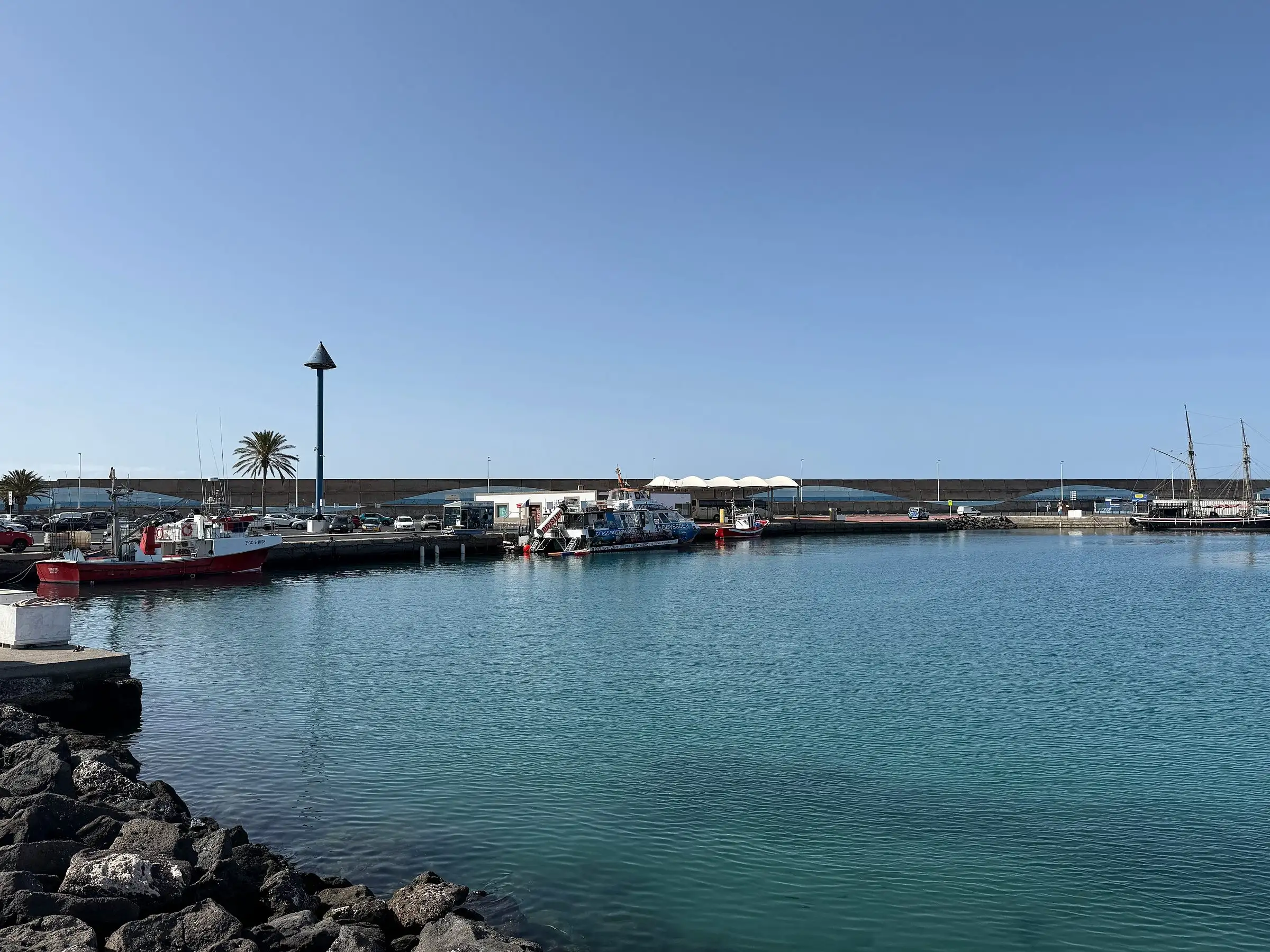
From here to Gran Canaria: fishing boats, pleasure boats and ferries in the harbour
Fishing boats, excursion boats and the ferries to Gran Canaria all dock at Morro Jable harbour. It lies a little outside the town to the west, a good ten minutes’ walk from the centre. Fred. Olsen and Baleària sail to Las Palmas de Gran Canaria, and the crossing takes about two hours. Check current times and fares with the ferry companies directly.
Boat trips along the coast also leave from the harbour.
Prawns, sole and time for their guests: where we go to eat
Along the promenade, one fish restaurant follows another. The classics are fresh fish of the day, prawns and papas arrugadas (wrinkled potatoes) with mojo (spicy sauce).

We often have prawns or sole here, but we don’t stick to anything in particular. Mostly Mediterranean, and sometimes we head up into the town for a pizza. One place I can name: La Laja on the promenade. The terrace is a wonderful place to sit, and they serve fresh fish and the island’s specialities. But as everywhere, it all depends on the staff.
Von perfekt bis „da geht mehr“ haben wir da schon alles erlebt.
One place has stayed in my memory in particular: the Bodega de Jandía, a tapas bar in the middle of the old town. The owner is well known locally; it’s really cosy, but it’s also busy. If you want to be sure of a table, book. We’ve never had the conveyor-belt tourist treatment there – they take time for their guests, and that’s exactly what we love.
For shopping, Jandía has supermarkets, clothes shops and souvenir shops along the main road, and you’ll also find supermarkets in Morro Jable.
There’s more going on in the evening in Jandía than in Costa Calma: bars, restaurants, music in the hotels. But it’s not a party resort like Corralejo in the north. Around 16 July, Morro Jable celebrates the Fiesta del Carmen for the patron saint of fishermen, with a boat procession out at sea.
Morro Jable month by month: weather and sea
This is what the year looks like on average: day, night and sea, month by month. The air temperature is measured by the weather station at the airport; the sea figures apply off Sotavento in the south. Our guide Best time to visit Fuerteventura covers which month suits you.
Tap a month to see all figures
| Month | Day (average high), °C | Night (average low), °C | Sea, °C | Sunshine (hours per day) | Rainy days (≥ 1 mm) |
|---|---|---|---|---|---|
| January | 20.8 | 14.9 | 19.0 | 6.3 | 2.3 |
| February | 21.1 | 14.9 | 18.4 | 6.8 | 1.9 |
| March | 22.3 | 15.5 | 18.5 | 7.7 | 1.8 |
| April | 23.2 | 16.4 | 19.0 | 8.3 | 0.8 |
| May | 24.7 | 17.7 | 19.8 | 9.2 | 0.2 |
| June | 26.3 | 19.5 | 21.0 | 9.5 | 0.0 |
| July | 27.5 | 21.1 | 21.9 | 9.8 | 0.0 |
| August | 27.9 | 21.9 | 22.7 | 9.4 | 0.1 |
| September | 27.5 | 21.5 | 23.1 | 8.7 | 0.5 |
| October | 26.4 | 20.2 | 22.9 | 7.3 | 1.8 |
| November | 24.2 | 18.0 | 21.8 | 6.5 | 2.1 |
| December | 22.1 | 16.1 | 20.2 | 6.2 | 2.6 |
Air: © AEMET, climate normals 1991–2020, Fuerteventura Aeropuerto station · Sea temperature: Copernicus Marine Service (EU) – Generated using E.U. Copernicus Marine Service Information, monthly means 1991–2020
Arriving early pays off: getting there, buses, taxis and parking
From the airport it’s about 70 minutes by car, roughly 85 kilometres south on the FV-2. Without a car, line 10 of the TIADHE island buses runs from the airport to Morro Jable. Line 5 shuttles between Morro Jable and Costa Calma via the hotel zones. Line 111 runs towards Cofete and Punta de Jandía. Current times are on tiadhe.com.
A taxi from the airport costs about €115 to €125 on the meter, more at night, on Sundays and on public holidays. There are no fixed prices. If you’re getting around by hire car anyway, you’re more flexible down here in the south.
Parking is the catch in Morro Jable. There are larger car parks, though they’re often full, and a long parking zone along the road right by the beach. All in all, the whole place is always parked up. We don’t have a regular spot; we decide on the day. My advice: come early – that gives you the best chance.
Everything you need day to day is here: chemists (farmacia), banks, cash machines and a health centre.
The gateway to the wild south: Cofete, the lighthouse and the salt marsh
Morro Jable is the gateway to the wild south of the peninsula. Beyond the town, the Jandía Natural Park begins.
The best-known trip is to Cofete on the north-west coast, with its endless beach and the Villa Winter. Just before Morro Jable the dirt track turns off the main road to the right, marked only by a small sign. Whether you’re allowed to take your hire car on dirt tracks depends on your hire contract. Our hire company, Cabrera Medina, doesn’t allow it with any of its cars, not even the jeep, and you then pay for any damage to the underbody yourself. I drive out there on roughly every other stay, most recently in 2023. You really must stop at the top of the pass: this is where you see Cofete beach for the first time, and the wind is insane – you can literally lean into it. I’d never experienced anything like it before. Lots of people just drive past, yet this is exactly where you get the best shot of Cofete. If you’d rather walk, an old path takes you through the Gran Valle and over the mountains to Cofete.
Heading west along the coast, you come to Punta de Jandía with its lighthouse, the south-western tip of the island, and to the small fishing village of Puertito de la Cruz. Along the way, tracks branch off to deserted coves. In May 2026 we drove out towards the lighthouse and stopped at the places where the hiking trails start up into the mountains.
The El Saladar salt marsh: between the main road and the beach lies the Saladar de Jandía, one of the rare salt marshes on the coasts of the Canaries. It covers about 127 hectares and is protected as a wetland of international importance. Waders rest and breed here. In 2026 the Cabildo (island government) decided to return more than 9,000 square metres of it to its natural state. Stay on the paths – the salt marsh is fragile.
The turtle centre at the harbour: young sea turtles are raised here and injured animals are nursed back to health. The project began in 2006 with loggerhead turtle eggs (Caretta caretta) brought from Cape Verde to the beach at Cofete. Entry is free, and a small visitor centre explains marine conservation. With children it’s a must, ideally combined with a wander round the harbour.
We’ve been there ourselves. We think it’s a great thing that injured sea turtles are cared for here so that, if at all possible, they can return to the sea. What did give us pause, though, were the tanks, some of them quite small and bare – even if it’s a rescue centre and not a zoo. Something else that bothers us is how limited the visiting hours are: it only opens on certain mornings, and you have to book in advance. It’s best to check the current times before you go. Even so, the important work there is worth seeing – just with the right expectations, because there isn’t much to see. The centre is run by the Cabildo, and in summer volunteers help look after the animals. Credit to the people who care about this and give up their time for it. Work like this is so important – you can’t stress that enough.
The church and a view over the town: from the church of Nuestra Señora del Carmen, founded in 1992, you look out over the beach and the lighthouse.
Pico de la Zarza: the island’s highest mountain is 807 metres high, and the climb starts in Morro Jable. Allow for about seven and a half kilometres of steady uphill walking and roughly three hours, then back the same way. The route is well signposted, and there’s almost always wind at the top. Start early and take plenty of water and a jacket.
Jandía Golf: an 18-hole course in the Barranco de Vinamar above the town, set in a hollow between the mountains. After a break of several years, it has been open again since December 2014.
Playa de Butihondo and Esquinzo (east of the hotel zone): a wide, golden sandy beach of about one and a half kilometres, with the Blue Flag in 2026. Depending on the wind direction, waves build up here, so watch the flag.
Cofete by bus: line 111 runs from Morro Jable to Cofete in about 55 minutes, according to the timetable information. Cofete is not suitable for swimming – the beach is considered extremely dangerous and has no lifeguards. It’s about 21 kilometres on the dirt track to Puertito de la Cruz at the western tip.
Costa Calma and the Sotavento lagoon (about 20 to 25 minutes by car): kilometres of pale beaches, the lagoon at Playa Barca and the waters where the Windsurfing World Cup is held.
You’ll find all these places on our island map.
Rays in the harbour basin: things to do here
Boat trips: catamaran tours along the south coast leave from the harbour, for example trips of several hours with food and drinks on board. They’re usually booked through activity websites. We’ve been out on the catamaran from Morro Jable ourselves, and we’ve also done an ordinary boat trip from the harbour.
Diving: there are several dive centres in Jandía offering dives along the south coast.
Water sports: the big clubs on the beach offer their guests windsurfing, stand-up paddleboarding and sailing. For kitesurfing and windsurfing lessons that aren’t tied to a hotel, head to Sotavento: the Matas Bay centre picks up its students in Morro Jable free of charge.
With children: the lifeguarded Blue Flag beach, the turtle centre and the harbour basin, where you can often watch rays.
Festivals and market: 2 July is a public holiday throughout Pájara municipality, and on 16 July Morro Jable celebrates the Virgen del Carmen. Don’t miss the weekly market: according to mercadillos.org, it takes place on Mondays and Thursdays from 9am to 2pm in Calle Bentejuy, with leather goods, jewellery, aloe vera care products, salt from the island, mojo and African crafts. Other sources give other days, so it’s best to ask at your hotel beforehand.
How we get both: Costa Calma or Jandía?
Jandía is livelier, Costa Calma quieter. In Jandía you can stop for a drink or a meal anywhere, and there’s the promenade, the harbour and more life in the evening. On the other hand, more of it is built up, and parking is scarce. Costa Calma is the place to unwind, with open space and the lagoon on your doorstep.
I stay in Costa Calma and like driving over to Jandía. That way we get both.
| At a glance | Jandía / Morro Jable | Costa Calma |
|---|---|---|
| Atmosphere | lively, promenade and harbour | quiet, a place to unwind |
| Evenings | bars, restaurants, music in the hotels, but not a party resort | not much going on |
| Beach | about 4 km from the hotel zone to the town, Blue Flag, lifeguarded | main beach a good 1.5 km, continuing to the Sotavento lagoon |
| Harbour and ferry | fishing harbour and marina, ferries to Gran Canaria | no harbour |
| Trip to Cofete | dirt track starts just before the town, bus line 111 | about 20 min to Morro Jable first |
| Parking | scarce, get there early | scarce |
| Taxi from the airport | approx. €115–125 | approx. €90–95 |
| Bus from the airport | Line 10 | Line 10 |
| Suits | anyone who wants life, the promenade and the wild south on the doorstep | anyone looking for peace, open space and long beach walks |
Each has its own character: staying in Jandía or in the town?
If you holiday here, you stay either in the hotel zone or in the old town. Each has its own character.
| At a glance | Jandía hotel zone (Solana Matorral) | Morro Jable town |
|---|---|---|
| Accommodation | large hotels and apartment complexes terraced up the hillside, many with sea views | mostly smaller hotels and apartments in the town |
| Getting to the beach | usually across the main road and past the El Saladar salt marsh | promenade and town beach right on the doorstep |
| Evenings | bars and restaurants along the main road | fish restaurants on the promenade, small bars in the lanes |
| Eating out | restaurants on the main road and in the hotels | fish on the promenade, pizza up in the town |
| Shopping | supermarkets, clothes and souvenirs on the main road | supermarkets in the town |
| Parking | scarce | scarce, especially tight in the town |
| Getting to the harbour | several kilometres depending on the hotel, on foot along the promenade or by bus | a good ten minutes on foot |
Accommodation is mainly large hotels and apartment complexes on the hillside, many with sea views. In 2015 we stayed at the Robinson Club Jandia Playa. The location right on the beach is fantastic, and the view from the tower out over the Atlantic is something special. But mealtimes were too hectic for us. These days a club isn’t for us any more; we’d rather be out and about.
From our research, so not tried and tested by us:
Riu Palace Jandía: five-star hotel right on Playa de Jandía, with a children’s pool. Suits couples and families looking for an upmarket hotel on the beach.
Occidental Jandía Playa: four-star hotel in the hotel zone, a few hundred metres from the beach, with half board or all-inclusive and a kids’ club for 4- to 12-year-olds. Aimed at couples and families.
Livvo Jandía Golf: hotel by the golf course in the Barranco de Vinamar, quiet above the town and open towards the sea. A good fit if golf matters more to you than having the beach on your doorstep.
Robinson Club Jandia Playa today: now adults only (18+), right on the beach, about two kilometres from the town centre, with plenty of sport and water sports on site.
Arrive late and you’ll be searching for ages: what bothers us about Morro Jable
Parking. If you come by car and arrive late, you’ll be searching for a long time.
Then there are the distances: there are several kilometres between the hotels in the east of the hotel zone and the old town. In some corners you can see that renovation is overdue, though not everywhere – lots of tourists come through here, and nobody wants to put them off. Some of the older hotels now stand empty, such as the Stella Canaris at the entrance to the town, which used to have a wonderful bird park in its garden.
With our feet by the water: Morro Jable in 1996 and today
| At a glance | 1996 | Today |
|---|---|---|
| Beach | we still went swimming, the stranded Rose of Sharon lay on the beach | the wreck has been gone since 2003, we just walk at the water’s edge |
| Willy Brandt | no statue yet | has sat on the promenade as a bronze figure since 2017 |
| Hotels | open, e.g. the Stella Canaris with its bird park | some old hotels stand empty |
| Townscape | better kept | renovation overdue, but less so than in Costa Calma |
