
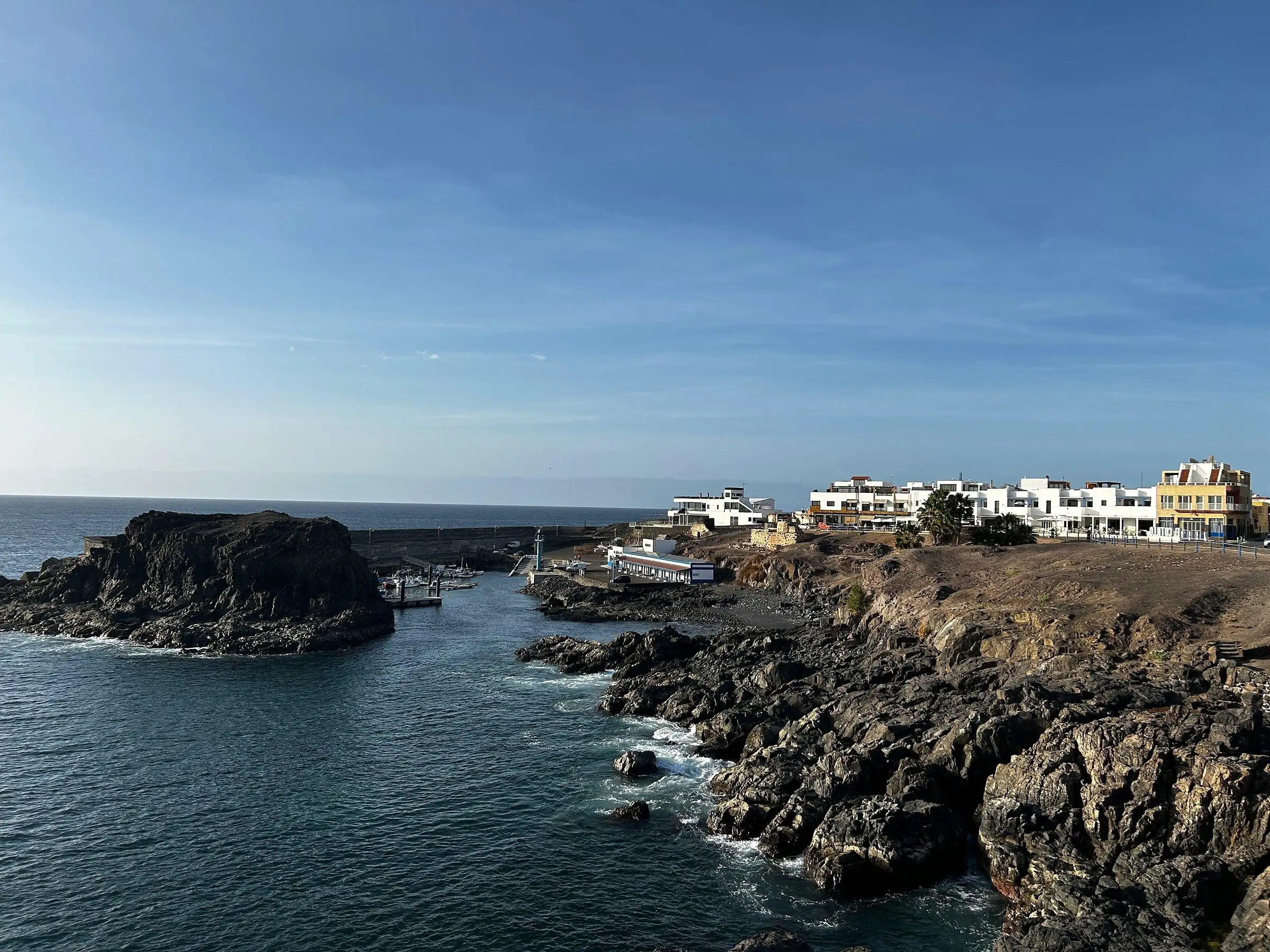

A fishing village with a history
El Cotillo is a small fishing village on the north-west coast, in the municipality of La Oliva, with just under 1,500 inhabitants (INE 2025). There are no big hotel blocks – instead you’ll find apartments, holiday homes, fish restaurants and surf schools. Most people who come here are looking for nature, the sea and something unspoilt.

The village has a longer history than you would guess from looking at it. It used to be called Puerto del Tostón and was one of the few harbours on the island allowed to export goods. The main cargo was lime, burnt in kilns right by the harbour, along with grain and fish. A reef off the harbour entrance made it hard for outsiders to sail in, which protected it from pirates. The round lime kilns of lava stone still stand at the harbour today.
In the 18th century the round watchtower, the Torre del Tostón, also known as Castillo de Rico Roque, was built to protect the coast – a counterpart to the tower at Caleta de Fuste. It has been a protected monument since 1949.
The old village centre lies further north at the Puerto Viejo, the old natural harbour. The houses here are packed close together, with steps and narrow lanes leading down to the water between them. This is exactly where it pays to just set off on foot: we wander through the village on every visit, including bits we haven’t explored yet, and see what turns up round the next corner.
The whale skeleton: Senda de los Cetáceos
On a viewing platform above the sea, the skeleton of a whale stands high up on a metal post. It is a Zifio de Cuvier, a Cuvier’s beaked whale, just under six metres long. These whales dive to depths of up to 3,000 metres and can stay underwater for more than two hours.

The skeleton is part of the Senda de los Cetáceos, the island government’s “Whale Trail”. In several places around the island there are skeletons of whales that were stranded on Fuerteventura’s coast, along with information boards shaped like a whale’s fin. They explain how the animals live and what part humans play in their deaths.
The beaches: lagoons to the north, surf to the south
El Cotillo has two completely different coastlines, and that matters for your safety. North of the village are the sheltered lagoons, south of it the open surf beaches.

To the north: shallow, calm swimming coves with pale sand have formed behind offshore reefs and tongues of lava – the Lagunas or Caletillas. The best known is Playa de La Concha, with a Blue Flag in 2026, along with Los Lagos and smaller coves towards the lighthouse. When the sea is calm and the tide is out, even small children paddle here. But calm does not mean free of danger: in September 2026 lifeguards had to pull swimmers out of a strong current at Los Lagos. Do not swim out beyond the edge of the reef.
To the south: from the watchtower, Piedra Playa, also called Playa del Castillo, stretches for kilometres – a wild, pale beach below cliffs. This is where surfers, kitesurfers and windsurfers meet. This stretch is dangerous for swimming, with big waves and a strong undertow. In August 2025 two men were rescued here at the last minute.
We have never swum here, but the surf beaches are a must for us. Sit down, watch the surfers, listen to the waves. From here the wild beaches run all the way down the west coast.
Which beaches have lifeguards, and when, is currently in flux: in 2026 the municipality of La Oliva renegotiated the lifeguard service on the west coast. So check the signs at the beach.
How windy is El Cotillo?
The north-west coast is a lot windier than the south, and in winter big waves often roll in. That is ideal for surfers. On windy days, though, the beach can get really unpleasant, with sand whipping into your face. On days like that, it is better to plan your beach time at the sheltered lagoons.
Lighthouse, museum and sunset
The Faro del Tostón lighthouse stands about four kilometres north of the village. There has been a light here since 1897; the current red-and-white striped tower has been in service since 1986 and stands on a barren stretch of lava coast. On the site, the Museo de la Pesca Tradicional shows how the island’s fishermen used to work. Opening hours vary, so check them with the municipality before you go.

El Cotillo is one of the best-known places on the island for watching the sunset. Here the sun goes down over the open Atlantic, whether you watch from the old harbour, the watchtower or the cliffs above Piedra Playa.
Dirt tracks run along the coast between the village and the lighthouse, past small coves. Walkers even hike from Corralejo via Majanicho to El Cotillo – a long, sunny day’s walk with no shade.
Eating out, shopping and evenings
Eating out in El Cotillo mostly means fish, in restaurants by the old harbour and along the coast, many with a terrace and sea views. Typical dishes are the catch of the day, papas arrugadas (wrinkled potatoes) with mojo (a spiced sauce) and the island’s goat’s cheese, queso majorero.
There are no big shopping centres, but there are small supermarkets, surf shops and a few craft shops.
There is no nightlife in the sense of clubs. In the evening people meet for dinner, for a beer after surfing and for the sunset.
Market and fiestas: on Fridays from 6pm to 10pm there is a small craft market on the plaza. In mid-August El Cotillo celebrates the Fiestas de Nuestra Señora del Buen Viaje – in 2025 from 15 to 17 August – with a procession on land and at sea in which the fishing boats take part. And in November, during the international kite festival, kites also fly over the beaches of El Cotillo – in 2026 from 9 to 15 November.
Where to stay in El Cotillo: by the lagoons or at the old harbour?
We haven’t stayed in El Cotillo ourselves yet – this is our research. You won’t find large resorts like those in the south – it’s mostly apartments and holiday homes. The main question is where.
- By the lagoons in the north: apartment complexes and holiday homes close to the calm swimming coves. Ideal with children and for anyone who wants to head down to the water first thing in the morning. It is a bit of a walk into the village centre.
- In the village and by the old harbour: small apartments and holiday flats, with the fish restaurants and the sunset right on your doorstep.
- For surfers: many stay in the village or in nearby Lajares; both are close to the surf beaches on the west coast.
From our research: Coral Cotillo Beach is the biggest hotel in the village, aimed at couples and families, five minutes’ walk from Playa de Los Lagos, with a children’s pool, a playground and sports facilities. The same group’s smaller Coral Cotillo Reef is in the village itself. On top of that there are plenty of private apartments and holiday homes by the lagoons and at the old harbour.
If you’re after an entertainment programme, a buffet and a hotel pool, you’re better off in Corralejo. Without a car you are limited in El Cotillo – a hire car is all but essential here.
Weather and sea temperatures through the year
This is what an average year looks like: day, night and sea, month by month. Air temperatures are measured at the weather station at the airport; the sea values apply to the waters off Corralejo on the north coast. Our guide Best time to visit Fuerteventura tells you which month suits you.
Tap a month to see all figures
| Month | Day (average high), °C | Night (average low), °C | Sea, °C | Sunshine (hours per day) | Rainy days (≥ 1 mm) |
|---|---|---|---|---|---|
| January | 20.8 | 14.9 | 18.9 | 6.3 | 2.3 |
| February | 21.1 | 14.9 | 18.3 | 6.8 | 1.9 |
| March | 22.3 | 15.5 | 18.3 | 7.7 | 1.8 |
| April | 23.2 | 16.4 | 18.8 | 8.3 | 0.8 |
| May | 24.7 | 17.7 | 19.7 | 9.2 | 0.2 |
| June | 26.3 | 19.5 | 20.9 | 9.5 | 0.0 |
| July | 27.5 | 21.1 | 21.7 | 9.8 | 0.0 |
| August | 27.9 | 21.9 | 22.5 | 9.4 | 0.1 |
| September | 27.5 | 21.5 | 23.0 | 8.7 | 0.5 |
| October | 26.4 | 20.2 | 22.8 | 7.3 | 1.8 |
| November | 24.2 | 18.0 | 21.5 | 6.5 | 2.1 |
| December | 22.1 | 16.1 | 20.0 | 6.2 | 2.6 |
Air: © AEMET, climate normals 1991–2020, Fuerteventura Aeropuerto station · Sea temperature: Copernicus Marine Service (EU) – Generated using E.U. Copernicus Marine Service Information, monthly means 1991–2020
Practical tips: getting there, taxis, parking
From the airport it takes about 40 minutes by car, around 42 kilometres via Puerto del Rosario and La Oliva. There is no direct bus from the airport. You go as far as Puerto del Rosario and change there to route 7. From Corralejo you can take route 8. Current timetables are on tiadhe.com. Without a car you are limited here; a hire car makes the north much easier.
A taxi from the airport costs about €64 to €73 on the meter, more at night, on Sundays and on public holidays. There are no fixed fares.
We have had few problems with parking so far. There is parking by the lagoons in the north and at the watchtower. It only gets tight now and then in the old village centre, and spaces fill up quickly around sunset.
For everyday needs you’ll find small supermarkets, a pharmacy (farmacia) and cash machines. For a bigger shop, head to Corralejo or La Oliva.
Day trips from El Cotillo: along the west coast
El Cotillo is a good base for the north and for the wild west coast. In November 2023 we had a jeep. The day after our visit to El Cotillo we set off from here and drove south along the west coast on the dirt track until the evening. It was incredible – we took in every beach, and seen from a distance El Cotillo had a whole different kind of charm.
The classic trips by car from El Cotillo:
- Faro del Tostón and the fishing museum: about four kilometres north
- Lajares and the Calderón Hondo crater: about 10 minutes
- La Oliva: just under 16 kilometres, with the Casa de los Coroneles (a cultural centre in the old manor house, free entry) and the church of Nuestra Señora de la Candelaria
- Corralejo: dunes, harbour and ferries to Lobos and Lanzarote, about 25 minutes
- Montaña de Tindaya: the sacred mountain of the island’s original inhabitants, easy to see from the road heading south
We went past Piedra Playa and deserted coves such as Playa Jarugo. At the end the track went over a mountain and then down a steep, bumpy path to Los Molinos, a small, sleepy place with a fish restaurant down by the bay, where a little stream runs into the sea. We already knew the restaurant: in 2008 we had sat on its terrace down there. But we had never arrived from above. Birgit panicked on the way down; I loved it, because from up there you really could see everything. Birgit didn’t want to go down, but she didn’t want to turn back either.
The dirt tracks on the west coast are not for every car. They are stony, steep in places and a long way from anywhere, so take water with you. Whether you are allowed to take a hire car on dirt tracks depends on your hire contract. Our hire company, Cabrera Medina, does not allow it with any of its cars, not even the jeep, and if you do it anyway you pay for any damage to the underside yourself. We drove the track anyway. I knowingly took that risk myself and would have paid for any damage out of my own pocket. This is not a recommendation.
It is about 25 minutes to Corralejo, with its dunes and the ferry to Lanzarote. On the way you pass Lajares, a small village with a surf scene and cafés, and right next to it the Calderón Hondo volcano, with an easy footpath up to the top.
Inland, La Oliva with the Casa de los Coroneles is worth a visit, and heading south you can see the sacred mountain of Tindaya from a long way off. You’ll find all these places on our island map.
El Cotillo or Corralejo?
El Cotillo is quieter and more unspoilt; Corralejo is livelier and more developed. In Corralejo you have hotels, bars, a promenade and the ferries. In El Cotillo you have a fishing-village feel, lagoons and surfers. Many people stay in Corralejo and come over to the lagoons at El Cotillo for the day.
| Aspect | El Cotillo | Corralejo |
|---|---|---|
| Atmosphere | quiet, fishing village, surfers | lively, touristy |
| Swimming | lagoons to the north, dangerous to the south | town beaches and dune beaches |
| Surfing | well-known spots right by the village | Flag Beach, more for kitesurfing and windsurfing |
| Evenings | dinner and sunset | bars, restaurants, nightlife |
| Accommodation | apartments, holiday homes | wide choice, hotels |
| Without a car | limited | good |
| Parking | mostly relaxed, tight in the centre | scarce, long search for a space |
| Airport | approx. 40 minutes | approx. 35 minutes |
What bothers us
For us El Cotillo is one of the most beautiful places on the island, but not everything is perfect here either. What strikes us most are the many vacant plots, building sites and buildings that look half-finished. They really don’t fit this lovely little fishing village. In the north especially there is now a lot of building going on, and we really hope El Cotillo doesn’t lose its original charm in the process.
Then there is the wind, which here on the west coast can get really unpleasant at times. Even so, we always love coming back, wandering through the lanes, sitting down somewhere by the sea and soaking up the special atmosphere.
El Cotillo ist einfach ein toller Ort, und wir hoffen, dass das auch in Zukunft so bleibt.
Then and now
In 1996 El Cotillo was still a sleepy fishing village. Today there are far more restaurants, holiday flats and apartment complexes, and tourism has grown noticeably. For us, though, the village has kept its special charm. But we do miss the old fishing village a little.
| Aspect | 1996 | Today |
|---|---|---|
| Village | sleepy fishing village | more restaurants, holiday flats, apartment complexes |
| Visitors | far fewer holidaymakers | noticeably more holidaymakers and surfers |
| Building | modest | many building sites, vacant plots, a lot of building in the north |
| Charm | unspoilt | still there, though we miss the old fishing village a little |
