A surfer is drifting out beyond the breakers, unable to get back alone, and a lifeguard races out from the beach on a jet ski. We’ve seen rescues like this on Fuerteventura. The people brought back were surfers who didn’t know what they were doing or had stopped paying attention for a moment.
Birgit and I have never had a close call in the water ourselves. Part of the reason is that I knew the score early on: my mate Holger had been coming to the island for years before I did and passed on what he knew. When Birgit came with me for the first time in 2005, I passed it on to her.
Fuerteventura is dangerous above all for people who don’t know what they’re doing. And there are quite a few of them. By mid-October 2026, twelve people had drowned on the island – twice as many as in the whole of 2025, according to the initiative “Canarias, 1.500 Km de Costa”. This page explains what the flags mean, where you can go into the water without worrying, where you can’t, and what to do if a current catches you.
What do the beach flags mean?
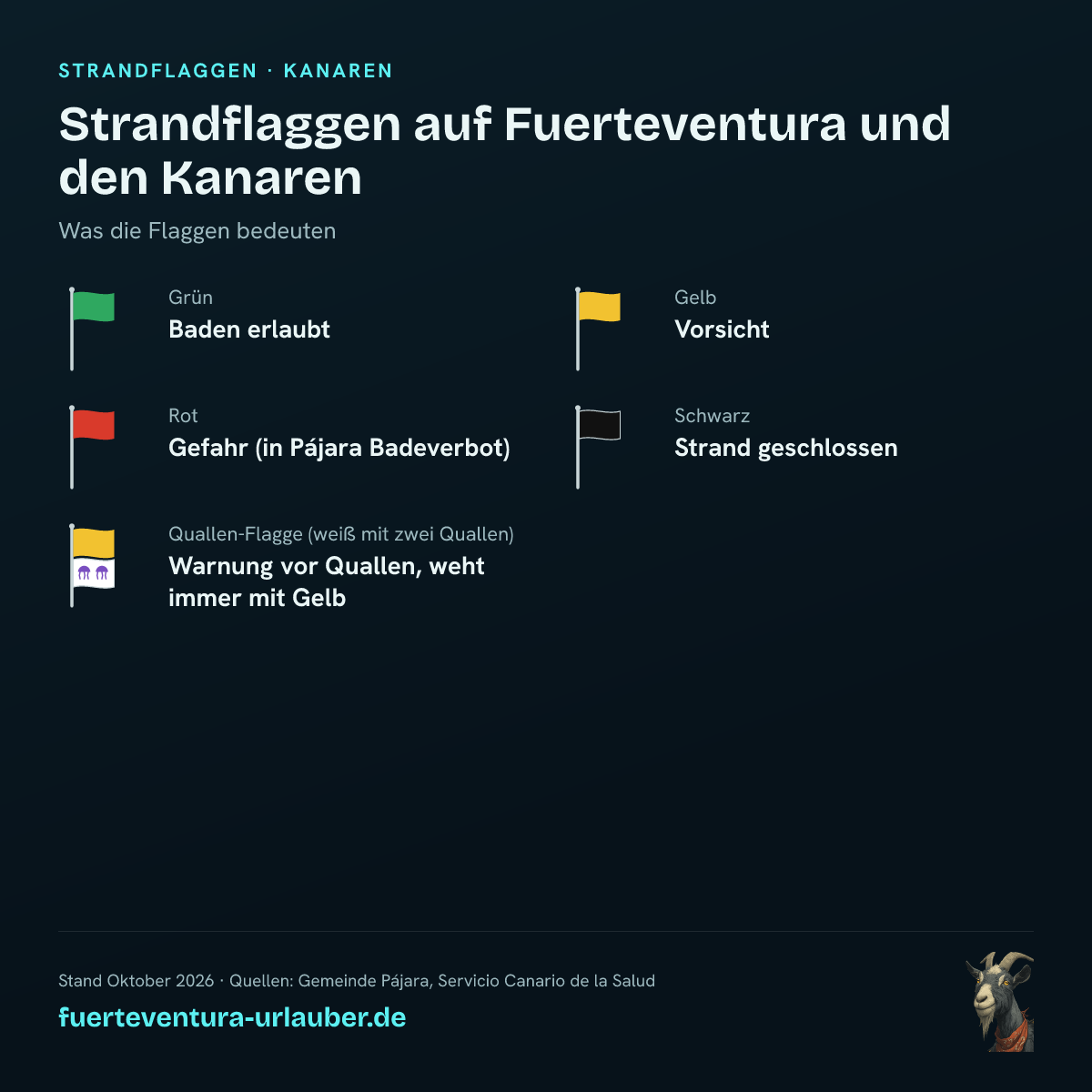
Every lifeguarded beach has a flagpole that you can see from the paths down to the sand. The flags are raised by the lifeguard service. At the moment there is no regulation covering all the Canary Islands: Spain’s Supreme Court overturned the 2018 decree in 2023, and a new law is not yet in force. The basic colours are the same everywhere, though, and that is also how the Canary Islands health authority explains them. Always check the flags – they show you the conditions right now. That is the most important rule in this whole article.
-
Green Swimming allowed
-
Yellow Caution
-
Red Danger (no swimming in Pájara)
-
Black Beach closed
-
Jellyfish flag (white with two jellyfish) Jellyfish warning, always flown with yellow
As of October 2026 · Sources: Pájara council, Servicio Canario de la Salud Save graphic as image

We always keep an eye on them. Even so, there are always people who ignore the flags or don’t understand them. In early September 2026, a lifeguard at the Grandes Playas near Corralejo pulled a family of four out of the water. According to the local press, warning flags were flying, but the family didn’t know what they meant.
The flags are put up by the lifeguard service. So if the tower isn’t staffed, nobody is telling you what the sea is like at that moment. Lifeguards in La Oliva advise against swimming in that case.
Why shouldn’t you swim on the west coast?
As a rule, you give the west coast a miss for swimming. The water there is treacherous, the current is ferociously strong and pulls you out. The only places you can swim there are sheltered, specially marked areas.
At Cofete and along the rest of the west coast we’ve only ever paddled. Even then you can feel the force of the water. Cofete has no lifeguards, and the initiative “Canarias, 1.500 Km de Costa” rates the beach as very dangerous. The German Foreign Office warns of life-threatening currents around the Canary Islands, and stresses that this applies even in perfectly normal weather.
Schwimmen dort, niemals. Je nach Jahreszeit, merkt man sofort womit man es zu tun hat, VORSICHT!!
What to do if a current pulls you out
The biggest danger is the rip current, also simply called a rip. The water that the waves push up onto the beach flows back out through a narrow channel, at up to 2.4 metres per second. No swimmer can make headway against that. The current pulls you away from the shore, but not under the water.

You can call the emergency number 112 free of charge and round the clock anywhere in the Canary Islands, and the control centre also speaks German. For emergencies at sea there is also Salvamento Marítimo (the Spanish maritime rescue service) on 900 202 202.
Where is it safe to swim on Fuerteventura?

We mainly go into the water at the beaches in the south, and at all the others we go in knee-deep at most. For us the southern beaches are the most beautiful anyway, and we like having them close by. We never go to black-sand beaches. The sand gets very hot, and I can do without that.
Beaches with a Blue Flag (Bandera Azul) are a useful pointer. The award recognises water quality and beach services – it does not guarantee calm water. In 2026, eleven beaches on Fuerteventura have the Blue Flag:
- La Oliva: Corralejo Viejo, Grandes Playas and La Concha in El Cotillo
- Pájara: Butihondo, Costa Calma, El Matorral and Morro Jable
- Puerto del Rosario: Playa Blanca, Los Pozos and Puerto Lajas
- Tuineje: Gran Tarajal
Sotavento: the lagoon and its pitfalls
On Sotavento beach, the lagoon comes and goes with the tides. At high tide you’ll see lots of children there, and beginner kitesurfers like using the lagoon too. There’s no simple rule, though. You have to tell the good spots from the bad ones: the channels that feed the lagoon tend to be deeper, the flooded edges shallower.
So be careful. My sister once underestimated it: in no time she was standing chest-deep in the water – fully dressed. You can drown even in a puddle. In the lagoon, keep an eye on the tide and never let children out of your sight.

Tides, stones and long beach walks
We walk a lot along the beach – Birgit likes to do it with her feet in the water. Two things are easy to underestimate. First, the distances: the beaches are vast, and you soon lose track of time. Second, the tides: when the water rises, it happens very quickly. In the Canaries the difference between low and high tide is a good metre and a half on average, and considerably more at spring tides (measured at the port of Las Palmas).
The stones at the water’s edge are treacherous too. In 2012, when we were staying at the Barlovento in Costa Calma, I sliced my foot open – not badly – and had to see a doctor. Because it isn’t easy to get off beaches like that, I walked a fair way further with the open wound. The doctor had to cut away tissue, clean it and disinfect it. Not pleasant, but it comes with the territory. The annoying part: the entertainment team had me down as a catwalk model that evening. Sadly I had to pull out – the fashion world got over it. Since then we always take a beach bag or a rucksack with the essentials.
What goes in the beach bag
Are there jellyfish on Fuerteventura?
I’ve never seen a jellyfish on Fuerteventura, and I can do without them. One got me on the Baltic once, and I’ve never been back since. They can’t be ruled out here, though. If they do turn up, a dedicated jellyfish flag warns you on the beach – in Pájara it is white with two jellyfish on it. The one people fear most is the Portuguese man o’ war (carabela portuguesa), whose tentacles can grow to 10 to 20 metres long.
Sometimes a weever fish (pez araña, “spider fish”) lies buried in the shallow sand – a small fish with venomous spines. The Spanish Society of Emergency Medicine recommends water shoes. If you are stung, remove the spines and hold your foot in water at about 45 °C for 60 to 90 minutes. If you have difficulty breathing or circulation problems, call 112 immediately.
How strong is the sun on the beach?
I never go to the beach without a hat. On Fuerteventura the UV index reaches the top level on the scale used by AEMET, Spain’s state weather agency: “extreme”, which means 11 or above. That happened on 9 June 2026, for example. On such days the Canary Islands health authority recommends SPF 50+, shade between about 11am and 5pm, a hat, sunglasses and long clothing. Babies under one year old should not be in direct sun at all.
My verdict
Fuerteventura has wonderful water, but the Atlantic is not a boating lake. If you read the flags, swim in the south and only ever paddle on the west coast, you’ll have safe and lovely beach days here. If you think swimming is swimming wherever you are, you are underestimating this sea – and the 2026 figures show how high the price can be.
My clear view: on the west coast and at Cofete you don’t swim – ever, however calm it looks. A red flag means get out of the water. And a beach without a staffed lifeguard tower is not a beach for swimming out. This article matters to me because there are always people who ignore the flags or don’t understand them.
How to get the most out of it: on the beach, look at the flagpole first. Pack a hat, water and water shoes. And then do what Birgit does – don’t lie around all day, walk, with your feet in the water. Even when the water is a dreamy turquoise, you miss everything if you don’t take a long walk along the beach. I know the Baltic and I know Fuerteventura, and they are worlds apart. Here it isn’t just the water, it’s the way sea, mountains, desert, peace and wind all come together.