
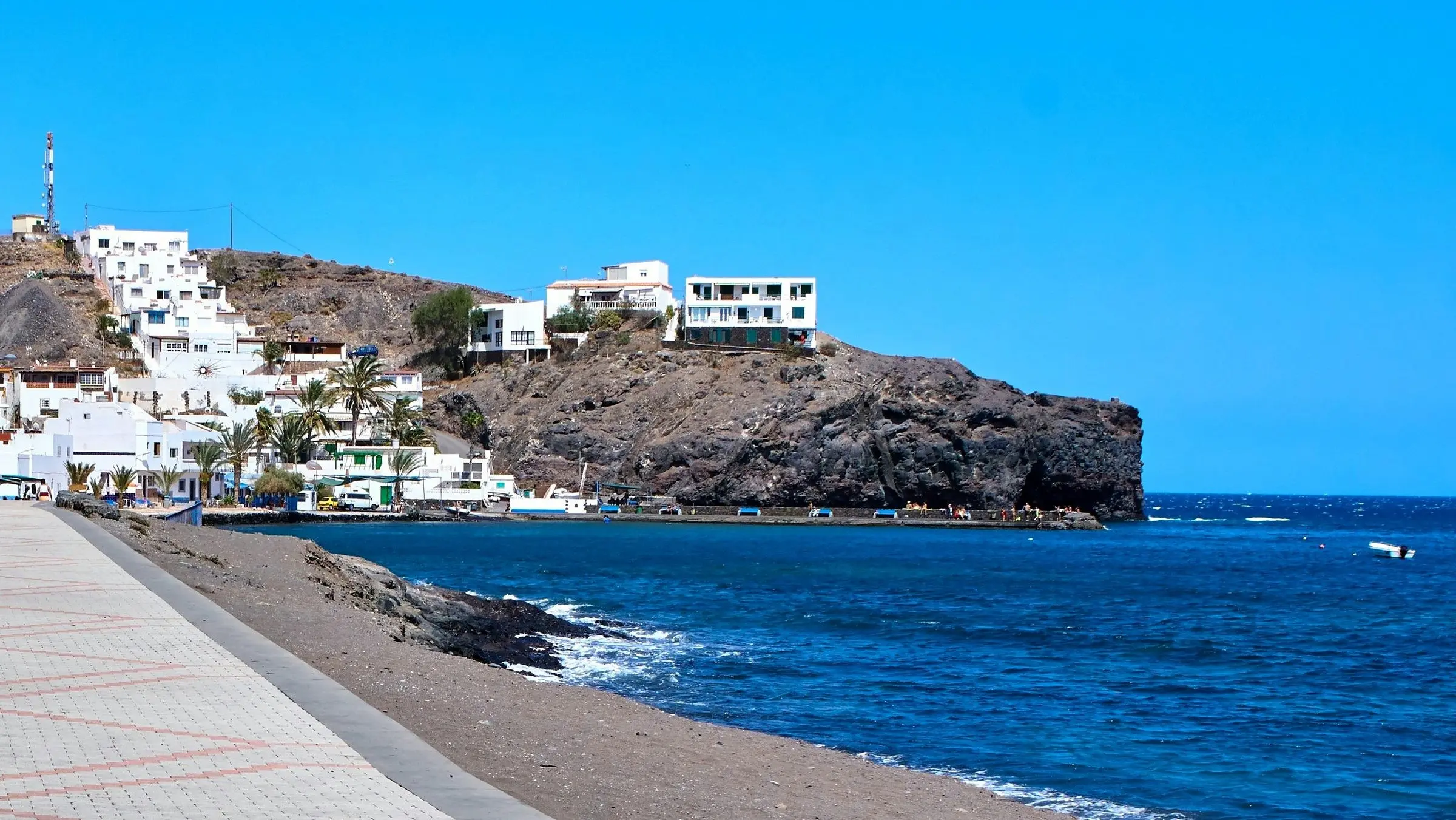

Las Playitas: the white fishing village
Las Playitas is a small fishing village on the east coast, a few kilometres east of Gran Tarajal. It belongs to Tuineje municipality. The name means “the little beaches”, and that’s exactly what you’ll find here: a few coves below a hillside.
The first thing you notice is the white houses. They climb the hillside from the water, with narrow lanes in between. Down below, a promenade runs to the little harbour where the fishing boats are moored. That’s our favourite place to sit.
Für uns ist das einer der schönsten kleinen Orte auf Fuerteventura, den viele Urlauber wahrscheinlich gar nicht auf dem Schirm haben.
The beach: dark, and more for looking at
The main beach is Playa de Las Playitas next to the village, about 700 metres long. The sand is dark and mixed with stones, and the water is mostly calm. You can hire sunloungers and parasols. The beach has no Blue Flag, and there’s no public record of whether it is lifeguarded. Like all beaches in Spain it is public, even though it lies in front of a holiday complex.
To be honest, we’ve never really been swimming here. At most we’ve had a paddle. Even so, we always have flip-flops and a towel with us so we can be spontaneous. Luckily many beaches have small foot showers, because sometimes the sand clings as if it had barbs. For proper swimming we prefer to drive to the pale sandy beaches.
Sport and golf: the resort next door
Right next to the village is the Playitas Resort, a large complex for sports holidays. It has a 50-metre pool with eight lanes, a cycling centre with more than 250 hire bikes (hotel guests only), a climbing wall and running routes. Las Playitas golf course has 18 holes and lies among the brown hills behind the beach.
We’ve never stayed at the resort, but we have had a look round. Every time we’re at the golf course I’m itching to finally play a round. I’m sure I’ll do it one day. First, though, I need some practice, because I’ve never played anything more than mini golf.
You can go underwater too: the dive centre Deep Blue Diving is based at the resort, with courses for everyone from beginners to experienced divers, including theory, practice in the pool and dives in the sea. If you’re not staying there, it’s best to ask them directly whether you can join in.
The Entallada lighthouse: very close to Africa
The Faro de la Entallada, the lighthouse on Punta de la Entallada, is an absolute highlight for us. Whatever you do, don’t skip this detour. Even the drive is a small adventure: the road winds up through the barren mountains and gets fairly narrow towards the end. Drive slowly and expect oncoming traffic.

At the top you’re standing about 200 metres above the sea, at the point of the Canary Islands closest to Africa. The Moroccan coast near Tarfaya is a good 100 kilometres away as the crow flies. We won’t forget the view over the steep cliffs and the Atlantic in a hurry. And then there’s the lighthouse itself: built of reddish natural stone in the style of the old island architecture and in operation since 1954. Out comes the camera, of course. The old keepers’ houses hold changing exhibitions, and wooden steps lead to the viewpoint.

Where to eat: Casa Victor
Our tip in Las Playitas is Restaurante Casa Victor on Calle Los Andenes, a rather unassuming place serving Canarian food and fish, with a view of the boats. We particularly recommend the grilled fish platter. Add some papas arrugadas (wrinkly potatoes) with mojo (a seasoned sauce) and a cold drink. That’s all you need.
This is exactly the kind of small restaurant we like: you just eat well and lose track of time. That’s what matters most to us on holiday.
Where to stay in Las Playitas
The biggest choice is at the Playitas Resort right next to the village. It has three parts:
- Playitas Hotel: 167 double rooms, 52 junior suites and 4 suites with their own pool, geared entirely to sports holidays.
- Playitas Aparthotel: 114 studios and 96 apartments in seven buildings.
- Playitas Villas: 24 villas, each with its own pool.
In the village itself you stay in holiday flats and small apartments, closer to the harbour and village life. The information in this section comes from our research, not from staying there ourselves.
Weather and sea temperature through the year
This is what the year looks like on average: day, night and sea, month by month. Air temperatures come from the weather station at the airport; sea temperatures are for the waters off Sotavento in the south. Our guide Best time to visit Fuerteventura covers which month suits you.
Tap a month to see all figures
| Month | Day (average high), °C | Night (average low), °C | Sea, °C | Sunshine (hours per day) | Rainy days (≥ 1 mm) |
|---|---|---|---|---|---|
| January | 20.8 | 14.9 | 19.0 | 6.3 | 2.3 |
| February | 21.1 | 14.9 | 18.4 | 6.8 | 1.9 |
| March | 22.3 | 15.5 | 18.5 | 7.7 | 1.8 |
| April | 23.2 | 16.4 | 19.0 | 8.3 | 0.8 |
| May | 24.7 | 17.7 | 19.8 | 9.2 | 0.2 |
| June | 26.3 | 19.5 | 21.0 | 9.5 | 0.0 |
| July | 27.5 | 21.1 | 21.9 | 9.8 | 0.0 |
| August | 27.9 | 21.9 | 22.7 | 9.4 | 0.1 |
| September | 27.5 | 21.5 | 23.1 | 8.7 | 0.5 |
| October | 26.4 | 20.2 | 22.9 | 7.3 | 1.8 |
| November | 24.2 | 18.0 | 21.8 | 6.5 | 2.1 |
| December | 22.1 | 16.1 | 20.2 | 6.2 | 2.6 |
Air: © AEMET, climate normals 1991–2020, Fuerteventura Aeropuerto station · Sea temperature: Copernicus Marine Service (EU) – Generated using E.U. Copernicus Marine Service Information, monthly means 1991–2020
Practical info: getting there, bus, taxi
By car it takes about 40 minutes from the airport, roughly 42 kilometres along the FV-2 to Gran Tarajal and then on to Las Playitas. Without a car, take bus 10 to Gran Tarajal and change there to bus 12 for Las Playitas. Current times are on tiadhe.com.
A taxi from the airport costs about €65 on the meter, more at night, on Sundays and on public holidays. If you want to see more of the island, you’re far more flexible with a hire car. For a bigger shop, doctors and pharmacies, you go to Gran Tarajal.
Around Las Playitas: what’s worth seeing nearby
Las Playitas sits in the middle of the quiet east coast. The Entallada lighthouse is practically on your doorstep, and a lot of other places are only a short drive away. Distances are as the crow flies.
- Gran Tarajal (approx. 4 km): a small Canarian town with a dark town beach, a long promenade, a harbour and lots of murals on its buildings.
- Cuchillos de Vigán: rugged ridges very close by, protected as a natural monument.
- Giniginámar (approx. 9 km): a sleepy fishing village with a shingle beach and clear water, good for snorkelling.
- Tarajalejo (approx. 14 km): a long, natural dark beach with a level promenade and artworks made of rusty steel.
- Karting El Cardón (approx. 14 km): an open-air go-kart track, with karts for children too.
- Oasis Park near La Lajita (approx. 17 km): a large animal and plant park with camels, good for a whole family day out.
- Tiscamanita windmill museum (approx. 15 km): a restored windmill where you find out how gofio (toasted grain flour) is made.
- La Atalayita in the Pozo Negro valley: a settlement of the island’s original inhabitants with more than 115 stone structures and a small visitor centre.
- Pozo Negro (approx. 14 km): a tiny fishing village with a stony beach and two places to eat by the sea, popular with locals.
You’ll find all these places on our island map.
Festivals in Las Playitas
Around 29 June, Las Playitas celebrates its patron saint San Pedro, the saint of fishermen. For about two weeks there are games, tournaments, evenings of dancing and water sports events. The highlight is the procession: the statue of the saint is carried through the lanes and then travels along the coast on a decorated boat, accompanied by lots of small boats. It all ends with a communal barbecue. Tuineje municipality publishes the exact programme.
Good to know
Las Playitas is small, peaceful and quiet in the evenings. There’s no nightlife. The beach is dark; for long, pale sandy beaches you head south or to Corralejo. In the village you can only buy the essentials. Without a car you depend on the bus and changing in Gran Tarajal.
