

Gran Tarajal: a small town, not a resort
Gran Tarajal is the largest town in Tuineje municipality and runs on everyday life, not on tourism. Just under 8,000 people live here, in a bay on the east coast. For the south of the island it’s an important place to go shopping. The holidaymakers you see are mostly day visitors.
The name comes from the tamarisks – tarajal in Spanish – that grow here. Around 1900, Matías López, who had returned from Cuba, did a great deal for the town: he paid for the parish church and supported the expansion of the harbour. One of the town’s streets now bears his name.
We like the fact that the town feels far more authentic than the typical holiday resorts. Ordinary local life still goes on here.
Genau das gefällt uns an Gran Tarajal, hier muss nicht alles besonders sein, um sich wohlzufühlen.
The beach: dark sand in the middle of town
Playa de Gran Tarajal is a town beach with dark sand, right in front of the promenade. It’s sheltered in the bay and the water is usually calm. As in 2025, it has a Blue Flag in 2026 – an award for water quality, safety and services that is awarded anew every year.
If you’re expecting light sand, you’ll be surprised. The sand is dark, and dark sand gets hot in the sun – water shoes aren’t a bad idea. We find the beach interesting, but it’s not our idea of a beach day. We’d rather take a leisurely stroll along the water; when we want to swim, we head for beaches with light sand. As so often, it’s a matter of taste.
Promenade and harbour
The heart of Gran Tarajal is its long seafront promenade. It’s lined with palm trees, cafés and colourful houses, and it’s where the locals meet. Our favourite thing is to sit down with a view of the sea, have a coffee and watch the world go by.
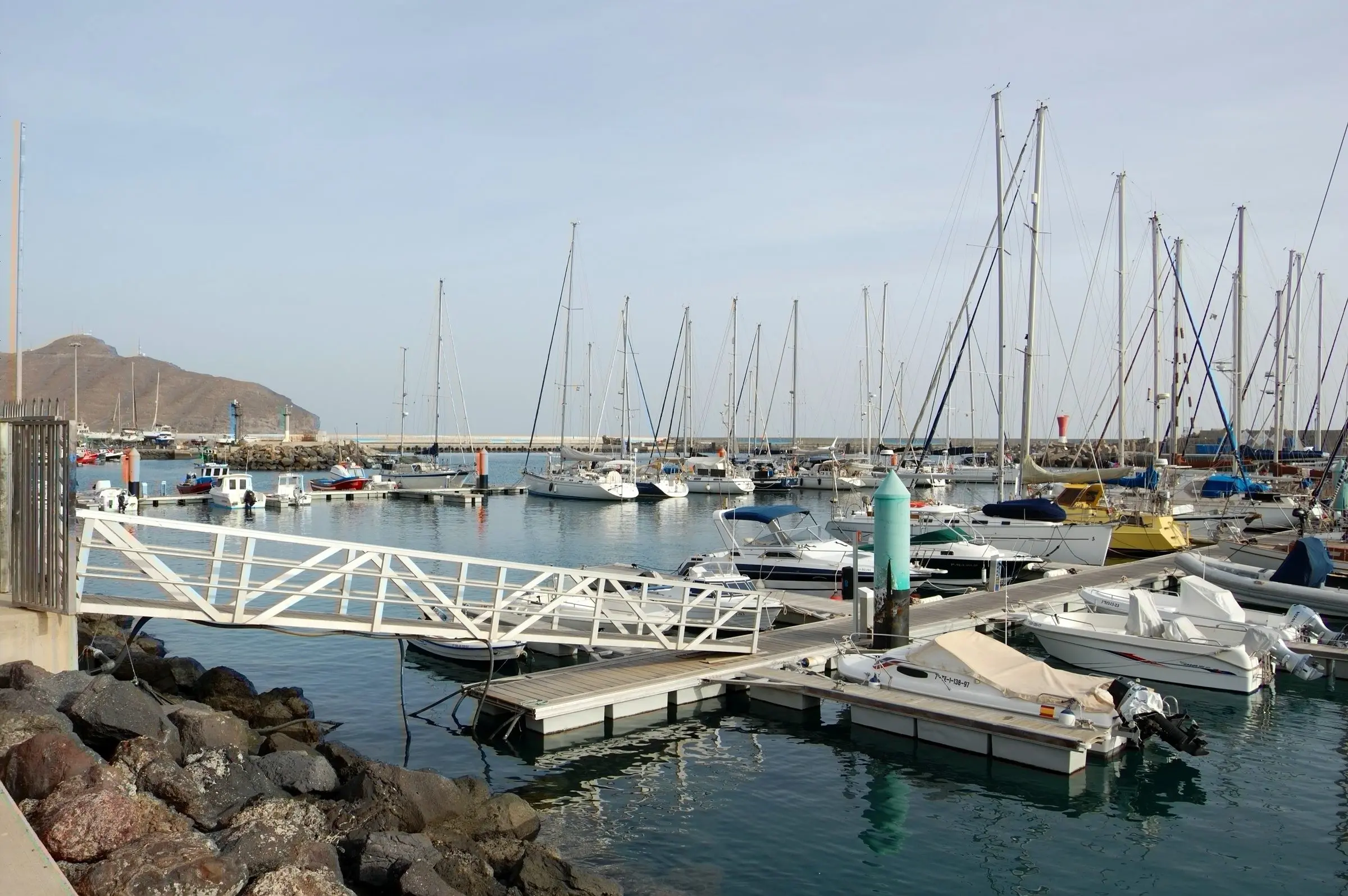
The promenade runs all the way to the harbour, where sailing boats and motorboats are moored. We like dropping by there without any particular aim. That’s exactly how Gran Tarajal works for us: stop, wander, stay put.

Things to see in Gran Tarajal
The parish church of Nuestra Señora de la Candelaria stands in the middle of town and dates from 1900. Right next to it is a fountain where the water splashes out of the mouths of six stone seahorses, surrounded by Canary palms. It’s a nice spot for a break in the shade.
As you wander round, it’s worth looking up: many house walls are painted with large murals. More than 30 of them have been created under the title Gran Tarajal y el Mar (Gran Tarajal and the Sea). The best way to find them is on foot, with no fixed plan.
In the Roque Negro district there’s also a whale skeleton. It’s part of a route that links several whale skeletons across the island.
Food and shopping
Eating out here is a spontaneous affair, and that’s a good thing. Our best memory is of a small bar right on the water, which you reach along a path leading out towards the sea. It’s a lovely place to sit, look out over the water and simply enjoy yourself. Between shopping trips we’ve also had an easy, no-fuss meal at a restaurant in the shopping centre. The typical food round here is fresh fish, papas arrugadas (wrinkly potatoes) and mojo (seasoning sauce).
For fresh fish, the restaurant La Cofradía right by the harbour has a reputation as a good place to go; it belongs to the local fishermen’s cooperative. You’ll find more restaurants, bars and gastrobars along the promenade, Avenida Paco Hierro, and in Calle Matías López. We researched these tips but haven’t tried them ourselves.
For shopping, Gran Tarajal matters to the whole south. There’s a large shopping centre and lots of small shops geared to local people. We shop here now and then and wander through the streets. If you have a holiday flat in the area, you’ll find everything you need day to day here.
Weather and sea temperature through the year
This is what an average year looks like: day, night and sea, month by month. Air temperatures come from the weather station at the airport; sea temperatures are for the waters off Sotavento in the south. To find out which month suits you, see our guide Best time to visit Fuerteventura.
Tap a month to see all figures
| Month | Day (average high), °C | Night (average low), °C | Sea, °C | Sunshine (hours per day) | Rainy days (≥ 1 mm) |
|---|---|---|---|---|---|
| January | 20.8 | 14.9 | 19.0 | 6.3 | 2.3 |
| February | 21.1 | 14.9 | 18.4 | 6.8 | 1.9 |
| March | 22.3 | 15.5 | 18.5 | 7.7 | 1.8 |
| April | 23.2 | 16.4 | 19.0 | 8.3 | 0.8 |
| May | 24.7 | 17.7 | 19.8 | 9.2 | 0.2 |
| June | 26.3 | 19.5 | 21.0 | 9.5 | 0.0 |
| July | 27.5 | 21.1 | 21.9 | 9.8 | 0.0 |
| August | 27.9 | 21.9 | 22.7 | 9.4 | 0.1 |
| September | 27.5 | 21.5 | 23.1 | 8.7 | 0.5 |
| October | 26.4 | 20.2 | 22.9 | 7.3 | 1.8 |
| November | 24.2 | 18.0 | 21.8 | 6.5 | 2.1 |
| December | 22.1 | 16.1 | 20.2 | 6.2 | 2.6 |
Air: © AEMET, climate normals 1991–2020, Fuerteventura Aeropuerto station · Sea temperature: Copernicus Marine Service (EU) – Generated using E.U. Copernicus Marine Service Information, monthly means 1991–2020
Practical information: getting there and buses
From the airport it’s around 41 kilometres south via the FV-2, about 35 minutes by car. Gran Tarajal is an important hub in the bus network: line 10 stops here on its way from the airport to Morro Jable, line 16 runs via Antigua to Puerto del Rosario and had its service considerably increased in 2026, and line 12 shuttles to Las Playitas. Current timetables are on tiadhe.com.

If you want to explore the east coast, a hire car gives you the most flexibility.
Where to stay in Gran Tarajal
Gran Tarajal isn’t a hotel town. If you stay here, it’s usually in a holiday flat in town or one overlooking the promenade. A small, simple option is the Hostal Tamonante.
You’ll find larger complexes with a pool in neighbouring Las Playitas: the Playitas Resort includes a hotel, an aparthotel and villas. The details in this section come from our research, not from staying there ourselves.
Around Gran Tarajal: places worth visiting nearby
Gran Tarajal sits in the middle of the quiet east coast, and a lot is just a short drive away. Distances are as the crow flies; by road it’s a little further.
- Las Playitas (approx. 4 km): white fishing village on a hillside with a promenade, a small harbour and a large sports resort with its own golf course.
- Faro de la Entallada (approx. 7 km): the lighthouse high above the cliffs at the south-eastern tip, with one of the finest views on the island. The last stretch of road is narrow and winding.
- Giniginámar (approx. 5 km): sleepy fishing village with a pebble beach and clear water, good for snorkelling. There’s hardly anywhere to eat by the beach.
- Tarajalejo (approx. 10 km): long, unspoilt dark beach with a level promenade – easy with a pushchair or wheelchair – plus artworks made of rusty steel.
- Karting El Cardón (approx. 11 km): open-air go-kart track inland, often pleasantly quiet, with karts for children too.
- Oasis Park near La Lajita (approx. 13 km): large animal and plant park with camels – plan a whole day for it.
- Tiscamanita Mill Museum (approx. 16 km): at the Centro de Interpretación de los Molinos you can see a restored windmill and find out how gofio (toasted grain flour) is ground.
- La Atalayita in the Pozo Negro valley: a settlement of the island’s original inhabitants with more than 115 stone buildings, some of which you can go into, plus a small visitor centre. A detour back to the time before the island was conquered.
- Pozo Negro (approx. 17 km): tiny fishing village with a stony beach and two restaurants by the sea, where lots of locals eat fish at weekends.
You’ll find all these places on our island map.
Festivals in Gran Tarajal
Come at the right time and you’ll see the town at its liveliest. The exact dates change every year; Tuineje municipality publishes the current programme.
- Candelaria (around 2 February): festival of the patron saint with Mass, a procession through the town, folk music and dancing. In some years the image of the saint is carried round the bay in a boat procession.
- Carnival (February or March): a contest of the murgas (satirical choirs), a big parade and, to finish, the Entierro de la Sardina (Burial of the Sardine) with fireworks.
- Fiestas Juradas de San Miguel (October, Tuineje municipality): they commemorate the Battle of Tamasite in 1740, when the islanders drove off English pirates. The English landing is re-enacted on the beach at Gran Tarajal.
Gran Tarajal or Las Playitas?
| Aspect | Gran Tarajal | Las Playitas |
|---|---|---|
| Character | small Canarian town with everyday life | white fishing village on a hillside |
| Beach | dark town beach in the bay, Blue Flag | around 700 m, dark sand with stones |
| Places to stay | only a few | large sports resort next door |
| Shopping | large shopping centre, lots of small shops | just the basics |
| Atmosphere | lively in the shopping streets and on the promenade | small, quiet, peaceful in the evenings |
| Bus | line 10 from the airport | line 12 from Gran Tarajal |
| Best for | the curious, self-caterers, long-stay visitors | people after peace and quiet, sporty types, fans of small fishing villages |
What we don’t like
Sometimes it’s simply too busy here for us, especially in the shopping streets and around the promenade. And the dark beach doesn’t tempt us into the water.
Even so, the town has a charm of its own. It’s less touristy and shows a different side of Fuerteventura. You should definitely see Gran Tarajal at least once.
Then and now
| Aspect | 1996 | Now |
|---|---|---|
| Promenade | plainer | more attractively laid out |
| Shops and restaurants | fewer | far more |
| Atmosphere | quieter | livelier, hectic in places |
| Character | everyday local life | thankfully still the case |
Since our first visit, Gran Tarajal has grown and become livelier. But it has kept a lot of its original character. Here you still get a feel for perfectly ordinary life on Fuerteventura.
